Frequently asked questions
Sizes, materials, custom pieces, ordering, delivery, care and installation: the studio's answers, written to be read on their own. Tribaliste is a creative studio in Marrakesh; every piece is designed in Marrakesh, made to order in Morocco in 10 to 12 weeks up to 3×2 m, 12 to 14 weeks above, from the launch of production, in standard US sizes or custom on quote. With DHL Express and FedEx, customs duties and import taxes are not included and are paid on receipt; with road freight, VAT is included and there is nothing else to pay.
About the studio & NICH
15What is Tribaliste?
Tribaliste is a creative studio based in Marrakesh that designs contemporary rugs and textile art. Every piece is designed in the studio and made to order. The studio works with architects, interior designers, hoteliers and private clients to develop pieces for specific spaces. Its baseline sums up the approach: "Rugs designed as architecture."
Link #studio-what-isWhere is the Tribaliste studio?
The Tribaliste studio is in Marrakesh, Morocco, at 497 Akioud, Sidi Ghanem, 40000 Marrakesh. Its showroom, The Lab, is at the same address and is open to visitors. Tribaliste ships its pieces worldwide from Marrakesh.
Link #studio-whereWho is behind Tribaliste?
Tribaliste was founded in 2016 by Nich, its founder and artistic director. He leads the design of the studio's collections and works alongside architects, designers and hoteliers on their projects. Nich also has a separate, more personal practice as an artist under the name NICH, presented on its own website.
Link #studio-who-foundedWhat is the difference between Tribaliste and NICH?
Tribaliste is the creative studio: it designs rugs and textile art for homes, hotels and design projects, sold through tribaliste.com. NICH is the artist's own name and practice, for more personal and exclusive work contact nasser@tribaliste.com
Link #studio-nich-differenceWhat does "Rugs designed as architecture" mean?
It means each Tribaliste rug is conceived as part of a space, not as a decorative accessory. The studio starts from proportions, light, materials and use, the way an architect would, and designs the piece to hold the room. That is why the studio works so closely with architects, interior designers and hoteliers.
Link #studio-approachWhat does Tribaliste offer?
Tribaliste offers four things: Collections (permanent pieces and editions in standard sizes), Artworks (textile art for the wall), Custom and Bespoke pieces (an existing design adapted, or a new piece created with the studio), and a trade programme for architects, designers, hoteliers and developers, presented on the For Professionals page.
Link #studio-what-offerIs Tribaliste a rug shop?
No. Tribaliste is a design studio and publishing house of editions: it designs its own pieces and produces them to order. It does not resell rugs from other makers and holds no stock. Clients can order standard sizes online or develop a custom piece with the studio.
Link #studio-shop-or-studioCan I visit the studio in Marrakesh?
Yes, come and see us. The Lab, the Tribaliste showroom at 497 Akioud, Sidi Ghanem, Marrakesh, presents a selection of pieces and the designs available to order. It is open Monday to Friday 9:30 am–6 pm and Saturday 9:30 am–5 pm, closed on Sunday. No appointment needed; for a custom project, let us know you are coming at hello@tribaliste.com or on WhatsApp at +212 8 08 52 43 35.
Link #studio-visitWho does Tribaliste work with?
Tribaliste works with architects, interior designers and decorators, hoteliers, developers, retailers and private clients. Many projects are residential; others are hotels and hospitality spaces. The studio can take on a single custom rug or a full programme of pieces for a building.
Link #studio-who-forWhere can I see Tribaliste projects?
Selected projects are shown on the Projects page of tribaliste.com, with photographs of the pieces in place. The studio only publishes projects it is authorised to show; for references relevant to your own project, write to hello@tribaliste.com.
Link #studio-projectsHow can press contact Tribaliste?
Journalists and editors can write to hello@tribaliste.com for high-resolution images, information on the studio or an interview. A press kit will be available for download.
Link #studio-pressWhen was Tribaliste founded?
Tribaliste was founded in 2016 by Nich, its founder and artistic director. The studio, based in Marrakesh, designs contemporary rugs and textile art, made to order, for private clients, architects, interior designers and hoteliers. Its approach is summed up in its baseline: "Rugs designed as architecture."
Link #studio-foundedDoes Nich design every Tribaliste piece?
Nich, as founder and artistic director, leads the design of the studio's collections, and every Tribaliste piece is designed in the studio in Marrakesh. Custom pieces are developed with the client from their brief, under the studio's direction, so each one is drawn for a specific space.
Link #studio-nich-designsDoes Tribaliste collaborate with other designers or artists?
Yes. Developing pieces with architects, interior designers and hoteliers for their projects is the core of the studio's work, through Create Together projects. To propose a collaboration, write to hello@tribaliste.com.
Link #studio-collabsDoes Tribaliste have a showroom or stockists outside Morocco?
The Tribaliste showroom is The Lab, in Marrakesh, open to visitors. From anywhere else, pieces are ordered online or directly with the studio, and professionals can request samples for their projects; the studio answers by e-mail or on WhatsApp at +212 8 08 52 43 35.
Link #studio-showrooms-abroadCollections & pieces
11What are Tribaliste Collections?
Collections are the studio's permanent pieces and editions: rugs designed by Tribaliste and offered in standard sizes at a fixed price. Each piece is made to order once you order it. Most designs can also be adapted in size, colour or finish on quote.
Link #coll-what-collectionsWhat is an edition?
An edition is a Tribaliste design published by the studio, in the way a design house publishes a chair or a lamp. Editions are produced to order in their listed sizes and colours.
Link #coll-editionDo you have rugs in stock?
No. Tribaliste holds no stock: every piece, whether a standard size or custom, is made to order. The standard production lead time is 10 to 12 weeks up to 3×2 m, 12 to 14 weeks above, counted from the launch of production; transit is added. This allows each rug to be made for your order, in the size and colourway you choose.
Link #coll-in-stockWill my rug look exactly like the photographs?
Very close, but not identical. Each Tribaliste piece is made by hand, so slight variations in colour, dimensions and texture are normal and make every piece unique. Screen colours can also differ from the actual wool. For a custom piece, you approve a sample before production.
Link #coll-uniqueHow are Tribaliste pieces named?
Each design has its own name, shown on its product page with its dimensions. Pieces are grouped into collections and series.
Link #coll-namesHow often do you release new pieces?
The studio releases new pieces and editions over the year. Trade programme members get early access to new pieces; private clients can follow new releases on Instagram (@tribaliste) or by subscribing to the newsletter.
Link #coll-newCan I reorder a piece that is no longer in the collection?
Often, yes: because every piece is made to order, the studio may be able to produce a past design again on quote. Write to hello@tribaliste.com with the name or a photo of the piece.
Link #coll-discontinuedCan I order matching rugs for several rooms?
Yes. You can order the same design in several sizes, or ask the studio to adapt one design across rooms in coordinated colours. Pieces ordered together are produced together, which helps keep colour consistent between them. Write to hello@tribaliste.com for a coordinated quote.
Link #coll-matchingDo you make round, oval or irregular-shaped rugs?
Standard pieces are listed in the shapes shown on each product page. Other shapes, such as round, oval or organic outlines, can be studied as custom projects on quote.
Link #coll-shapesCan I save pieces to look at later?
Yes. You can save pieces to a wishlist and find them again in your customer account.
Link #coll-wishlistCan I reorder the same rug later, or a matching piece?
Yes. Every Tribaliste piece is made to order, so a design in the collection can be ordered again at any time, in the same size or another one. Give your previous order number so the studio works from the same specification. Slight colour differences between production batches are normal with natural wool. As for any order, the standard production lead time is 10 to 12 weeks up to 3×2 m, 12 to 14 weeks above, counted from the launch of production; transit is added.
Link #coll-reorderChoosing a rug
13How do I choose the right rug for a room?
Start with size, then use, then design. Measure the room and the furniture the rug must hold, decide how much traffic it will take, and only then choose the design and colour that suit the light and materials of the space. For help, the studio can review your plans or photos at hello@tribaliste.com.
Link #choose-where-startShould I choose a hand-knotted (pile) rug or a flat-woven rug?
Choose a hand-knotted pile rug for softness, acoustic comfort and presence underfoot, in living rooms and bedrooms. Choose a flat-woven rug for a thinner, lighter profile: under dining chairs, near doors, in layered schemes or on the wall. Each product page states its technique.
Link #choose-pile-vs-flatHow do I choose a rug colour?
Look at the rug in the light of the room, not on screen. Light colours open a space but show marks sooner; deeper tones and multi-tone compositions hide everyday wear. Pick up one tone from the floor, walls or upholstery so the rug belongs to the room. Custom colourways are possible on quote.
Link #choose-colour-lightWhich rug works best in a living room?
In a living room, choose a rug large enough to anchor the seating group, ideally with at least the front legs of every sofa and armchair on it. A hand-knotted pile rug adds comfort and softens acoustics. See "What size rug do I need for my living room?" for exact dimensions.
Link #choose-livingWhich rug works best in a bedroom?
In a bedroom, the rug should extend well beyond both sides of the bed so your first step in the morning is on wool. A soft hand-knotted pile suits bedrooms, where traffic is light. Alternatively, place a runner on each side of the bed.
Link #choose-bedroomWhich rug works best under a dining table?
Under a dining table, choose a rug large enough for chairs to stay on it when pulled out, with a lower or flat-woven profile so chairs slide easily. Darker or patterned compositions forgive spills. See "How big should a rug be under a dining table?".
Link #choose-diningWhich rug works in a hallway or entrance?
In a hallway or entrance, choose a durable piece with a low profile so doors open freely and nobody trips on an edge. Runners suit corridors; a rectangular rug suits a square entrance. Add a doormat outside to keep grit off the wool. Check the door clearance before ordering a pile rug.
Link #choose-hallway-entryCan I put a wool rug in a kitchen or bathroom?
In a kitchen, yes, with care: wool resists stains better than many fibres, but a flat-woven piece is easier to clean. Bathrooms are not recommended: constant humidity keeps wool damp, which can cause odours and attract moths. If you do, ensure good ventilation and let it dry fully.
Link #choose-kitchen-bathCan Tribaliste rugs be used outdoors?
No. Tribaliste rugs are made in natural wool for indoor use. Rain, ground moisture and direct sun outdoors would damage the wool and fade the colours. A covered, dry space such as a closed veranda can work if the rug is protected from humidity and strong sun.
Link #choose-outdoorAre wool rugs a good choice with children and pets?
Yes, wool is a resilient choice: its fibres recover well from pressure and it releases many spills if they are blotted quickly. With pets, keep claws trimmed to avoid pulled loops or knots, and vacuum more often. Multi-tone compositions hide everyday marks best.
Link #choose-children-petsCan I layer rugs?
Yes. Layering works best with a large, thin base, often a flat-woven piece, and a smaller pile rug on top, offset or centred. Keep at least 30 cm (12 in) of the base visible on each side. Use an anti-slip underlay between the two so the top rug stays in place.
Link #choose-layeringCan the studio help me choose?
Yes. Send photos or plans of your space, its dimensions and the pieces you like to hello@tribaliste.com or through the chat on the site, and the studio will suggest sizes and designs. For custom and trade projects, the studio can also prepare a 3D visualisation.
Link #choose-adviceShould I choose a standard size or a custom rug?
Choose a standard size when one fits your furniture and margins: it is ordered directly online, at a fixed price. Choose custom when the room has constraints a standard size cannot meet, such as a niche, an unusual proportion or an exact colour to match; it is quoted by the studio. Both are made to order. The standard production lead time is 10 to 12 weeks up to 3×2 m, 12 to 14 weeks above, counted from the launch of production; transit is added.
Link #choose-standard-or-customSizes & measuring
25Which sizes are available?
Each product page lists its standard sizes in a drop-down menu, following common US formats. The site is in English, with sizes in feet and inches; switch to French with the FR toggle to see them in centimetres. Any other size can be made as a custom piece on quote. Sizes are given without fringes.
Link #size-standardHow do I convert rug sizes between feet and centimetres?
One foot equals 30.48 cm and one inch 2.54 cm. Common examples: 5 × 8 ft is about 152 × 244 cm; 6 × 9 ft about 183 × 274 cm; 8 × 10 ft about 244 × 305 cm; 9 × 12 ft about 274 × 366 cm. The exact dimensions of each size are shown on the product page.
Link #size-ft-cmHow do I measure a room for a rug?
Measure the length and width of the floor wall to wall, then subtract the border of bare floor you want to keep, usually 30–60 cm (12–24 in) on each side in a living room. Note doors, radiators, vents and built-in furniture. Then outline the rug on the floor with painter's tape and walk around it for a day before ordering.
Link #size-measure-roomWhat is the painter's tape test?
It is the simplest way to check a size before ordering. Mark the rug's exact outline on the floor with painter's tape, put the furniture in place, and live with it for a day or two. You will see whether chairs stay on the rug, doors clear it and the proportions suit the room.
Link #size-tape-testWhat size rug do I need for my living room?
Choose a rug large enough for at least the front legs of the sofa and chairs to rest on it, extending about 15–20 cm (6–8 in) beyond each end of the sofa. In most living rooms that means 8 × 10 ft (about 244 × 305 cm) or larger. Keep 30–60 cm (12–24 in) of floor visible around the edge.
Link #size-livingShould all the furniture legs be on the rug?
There are three good layouts. All legs on: the rug holds the whole seating group, the most generous option for large rooms. Front legs on: front legs of sofa and chairs rest on the rug, the most common. Floating: only the coffee table is on the rug, best for small rooms; the rug should then be at least as wide as the sofa.
Link #size-living-layoutsHow much wider than the sofa should the rug be?
Ideally the rug extends 6–8 in (15–20 cm) beyond each end of the sofa, so the seating looks anchored. As a guide: an 84 in (213 cm) three-seat sofa takes an 8 × 10 ft rug, a 100 in (254 cm) sectional takes 9 × 12 ft, and a loveseat takes 6 × 9 ft. If the rug must be narrower than the sofa, centre it on the coffee table.
Link #size-sofaHow big should a rug be under a dining table?
Add 24–30 in (60–75 cm) to every side of the table, so chairs stay on the rug when pulled out. As a guide, a 72 × 36 in (183 × 91 cm) table for six takes an 8 × 10 ft rug, and a 96 × 40 in (244 × 102 cm) table for eight takes 9 × 12 ft. Measure the table with its leaves if it extends, and prefer a flat or low profile so chairs slide easily.
Link #size-diningWhat rug shape suits a round dining table?
A round table is best served by a round or square rug about 48–60 in (120–150 cm) larger in diameter than the table, so chairs stay on the rug. A rectangular rug also works, especially in a long room, as long as it keeps 24–30 in (60–75 cm) of rug all around the table. Round and other custom shapes are studied on quote.
Link #size-round-tableWhat size rug do I need under a bed?
Let the rug extend 18–24 in (45–60 cm) beyond each side of the bed. As a guide, with the rug laid across the bed: 6 × 9 ft for a twin or full bed, 8 × 10 ft for a queen (60 × 80 in), and 9 × 12 ft for a king (76 × 80 in) or California king. Start the rug just in front of the nightstands, about two thirds of the way under the bed.
Link #size-bedCan I use runners beside the bed instead of one large rug?
Yes. A runner on each side of the bed, about 60–90 cm (2–3 ft) wide and roughly the length of the bed, is a good solution for smaller bedrooms or when the bed sits on a platform. A third runner can sit at the foot if there is space.
Link #size-bed-runnersHow do I size a hallway runner?
Leave about 10–15 cm (4–6 in) of floor on each side of the runner and 15–30 cm (6–12 in) at each end. In a 100 cm (39 in) wide corridor, that means a runner about 70–80 cm (2.5 ft) wide. Keep it clear of door swings. Runners can be made to your exact length as a custom piece.
Link #size-hallwayWhat size rug do I need under a desk?
The desk and chair should sit fully on the rug, with at least 60–90 cm (24–36 in) behind the desk so the chair never rolls off the edge. A low, dense pile or a flat-woven rug is best for a chair on castors; use a chair mat on top if the chair is used all day.
Link #size-officeWill my door open over the rug?
Check before ordering. Measure the gap between the bottom of the door and the floor: it must be greater than the thickness of the rug plus any underlay. Tribaliste hand-knotted rugs have a standard pile height of about 3 cm (1.2 in), so a flat-woven rug or a reduced pile height may suit doorways better.
Link #size-entry-doorIs a bigger rug always better?
Usually, yes: a rug that is too small is the most common mistake and makes a room feel fragmented. But leave a border of bare floor, typically 30–60 cm (12–24 in) in living rooms and 20–45 cm (8–18 in) in smaller rooms, so the rug frames the space instead of looking like wall-to-wall carpet.
Link #size-proportionsAre fringes included in the listed size?
No. Tribaliste sizes are given without fringes. On a hand-knotted rug with fringes, allow an extra 10–15 cm (4–6 in) in length. Most designs can also be ordered without fringes as a custom finish.
Link #size-fringesHow exact are the dimensions of a handmade rug?
Very close to the ordered size, with the slight variations normal for a piece made by hand. The tolerance is about ±2 in (5 cm) for sizes up to about 10 × 7 ft (3 × 2 m), and up to about ±4 in (10 cm) for larger sizes, measured flat without fringes. For built-in settings such as niches or stair runners, tell the studio, which will advise on the margin to allow.
Link #size-toleranceCan I order a rug in an exact custom size?
Yes. Most Tribaliste designs can be made to your exact dimensions as a custom piece. Send the dimensions (without fringes), the design and the room to hello@tribaliste.com or through Start a Project, and the studio sends a firm quote. Custom pieces are made to order. The standard production lead time is 10 to 12 weeks up to 3×2 m, 12 to 14 weeks above, counted from the launch of production; transit is added.
Link #size-custom-sizeWhat is the largest rug Tribaliste can make?
Very large formats are possible for residential and hospitality projects; the maximum single-piece size depends on the technique. Send your plan to the studio for a feasibility check.
Link #size-maxWhat size rug for an open-plan space?
Use one rug per zone rather than one giant rug: a 9 × 12 ft (about 270 × 370 cm) or larger under the seating group, a rug sized to the table in the dining area, and 2–3 ft (60–90 cm) of bare floor between them. Keep a common design language or colourway across the zones so the space reads as one.
Link #size-open-planShould the rug go under the coffee table?
Yes. The coffee table should sit entirely on the rug, centred in the seating group, with about 14–18 in (35–45 cm) between the sofa and the table. A rug that only fits under the coffee table makes the surrounding seats look disconnected, so size the rug to the whole seating group, not to the table.
Link #size-coffee-tableWhich way should a rug be oriented?
In a living room, the long side of the rug runs parallel to the sofa. In a bedroom, a rectangular rug is usually laid across the bed, its long side perpendicular to the bed, so it shows on both sides. Under a dining table, the rug follows the direction of the table, and in a hallway the runner follows the corridor.
Link #size-orientationShould a bedroom rug go under the nightstands?
It is a choice, not a rule. Stopping the rug just in front of the nightstands, about two thirds of the way under the bed, is the most common layout and needs 18–24 in (45–60 cm) of rug on each side. Running it under the nightstands reads as one calm plane but needs a larger size, such as 10 × 14 ft for a king bed.
Link #size-bed-nightstandsWhat size rug for a small living room?
In a small living room, choose a rug that takes at least the front legs of the sofa and armchairs, often 6 × 9 ft (about 180 × 270 cm) or 8 × 10 ft (about 240 × 300 cm), rather than a small accent rug floating in the middle. A slightly larger rug ties the furniture together and usually makes a small room look calmer, not smaller.
Link #size-small-roomWhat are the most common rug-sizing mistakes?
The most common mistake is a rug that is too small, leaving the furniture floating around it. Others: choosing the rug before the furniture layout, forgetting door swings and floor vents, measuring the room instead of the furniture group, and leaving uneven borders. Outlining the rug on the floor with painter's tape before ordering avoids almost all of them.
Link #size-mistakesMaterials, wool & making
16What are Tribaliste rugs made of?
Tribaliste rugs and wall pieces are made in 100% natural sheep wool from the Middle Atlas, as stated on each product page. They are designed in the studio in Marrakesh and made by hand in Morocco.
Link #mat-whatHow are Tribaliste rugs made?
Tribaliste rugs are hand-knotted or flat-woven in Morocco, following a design drawn in the studio in Marrakesh. Each piece is then washed, finished and inspected before it leaves the studio; the knotted technique gives a dense, durable rug with precise detail.
Link #mat-how-madeWhy wool?
Wool is resilient, naturally soil-resistant thanks to its lanolin, slow to ignite, insulating and comfortable underfoot. Its fibres recover after pressure, so a well-made wool rug keeps its look for decades. It also takes colour with depth, which suits the studio's compositions.
Link #mat-why-woolWhat is the pile height of a Tribaliste rug?
The standard pile height of a Tribaliste hand-knotted rug is 3 cm (about 1.2 in). Flat-woven pieces have no pile. A different pile height can be requested as a custom option on quote.
Link #mat-pile-heightWhat is the knot density?
Tribaliste knotted pieces use a double knot that gives a very high knot density, for a heavier rug and precise detail.
Link #mat-knot-densityHow heavy and how thick is a Tribaliste rug?
Weight and thickness depend on the surface. Pile (Édition Libre): 3 to 4 cm (about 1.2 to 1.6 in), about 4.5 kg/m² (about 0.92 lb/sq ft). Carved pile (Labyrinthe, Topography): 2 to 3 cm (about 0.8 to 1.2 in), about 4 kg/m² (about 0.82 lb/sq ft). Flatweave (Free Weave): about 0.5 cm (about 0.2 in), about 2.5 kg/m² (about 0.51 lb/sq ft). The weight of your piece is useful for shipping and for wall installations.
Link #mat-weight-thicknessWhat dyes are used?
The wool is dyed before it is knotted or woven, in the colours specified by the studio.
Link #mat-dyesDo Tribaliste rugs have a backing or glue?
A hand-knotted rug is built knot by knot on the loom, so the design shows on the reverse and no glued backing is needed. Flat-woven pieces are reversible in structure.
Link #mat-backingWhat are the fringes?
On a hand-knotted rug, the fringes are the ends of the warp threads on which the knots are tied, so they are part of the structure, not sewn on. Most Tribaliste designs can be ordered with or without fringes. Fringes are not included in the listed size; allow 10–15 cm (4–6 in).
Link #mat-fringesAre colour and texture variations a defect?
No. Because each piece is made by hand, slight variations in colour, texture and dimensions are normal and are not defects. Natural wool can also show subtle differences in tone between batches, known as abrash. Wear from use or care that does not follow the Care Guide is not a defect either.
Link #mat-variationsMy new wool rug has a smell. Is that normal?
Yes. New natural wool can have a faint, natural smell, especially after travelling rolled in its packaging. Unroll the rug, lay it flat and air the room well; the smell fades within a few days to a couple of weeks. If it persists, contact service-client@tribaliste.com.
Link #mat-smellAre wool rugs suitable for people with allergies?
Wool is a natural fibre, and regular vacuuming keeps dust from building up in the pile. Tribaliste does not give medical advice: if you have a wool or dust allergy, ask your doctor. A flat-woven piece holds less dust than a deep pile and is easier to clean.
Link #mat-allergiesHow is quality checked?
Every piece is inspected, photographed and sent to you before it is rolled and shipped. Custom pieces are also checked against the approved sample and quote.
Link #mat-quality-controlWhat is the difference between wool and synthetic rugs?
Wool is a natural protein fibre: resilient, naturally soil-resistant thanks to its lanolin, slow to ignite and able to absorb and release moisture, so it keeps its look for years. Synthetics such as polypropylene or polyester cost less and wipe clean easily, but they crush more, hold oily soil and melt rather than char. Tribaliste rugs are made in natural wool.
Link #mat-wool-vs-syntheticDoes a thicker rug mean better quality?
No. Thickness is a design choice, not a quality rating. Quality depends on the fibre, the density of the knots or weave, the finishing and how well the piece keeps its shape over time. A dense pile or a well-made flat weave can outlast a thick, loose pile. Choose the profile for the room: softness in a bedroom, a flat profile under dining chairs.
Link #mat-thicker-betterWhy does my rug look lighter or darker from different sides?
This is called shading, and it is normal for a pile rug. The wool fibres lean slightly in one direction, so light reflects differently depending on where you stand: the rug looks lighter when you look with the pile and deeper when you look against it. It is not a colour defect. Before placing the furniture, turn the rug to choose the direction you prefer.
Link #mat-shadingColours & custom
17Can I order a custom rug?
Yes. There are two ways. Explore & Customize: adapt an existing Tribaliste design in colour, finish (with or without fringes), pile height and dimensions. Create Together: develop a new piece with the studio from your brief. Both are made to order, on a firm quote. The standard production lead time is 10 to 12 weeks up to 3×2 m, 12 to 14 weeks above, counted from the launch of production; transit is added.
Link #custom-possibleWhat can be customised?
On most designs you can change the dimensions, the colours, the finish (with or without fringes) and the pile height. Shape, technique and a completely new design are studied on quote as a Create Together project.
Link #custom-what-changeHow does the custom process work?
Brief (space, dimensions, plans, moodboard, timeline, budget); design proposal and 3D visualisation; firm quote; sample approval; 60% deposit to start production; production, 10 to 12 weeks up to 3×2 m, 12 to 14 weeks above, from the launch of production; quality control in Marrakesh; 40% balance before shipping; tracked delivery; installation guidance.
Link #custom-processWhat should I send to start a custom project?
Send the space and its use, exact dimensions, plans or photos, a moodboard or reference pieces, preferred colours, quantity, delivery country, target date and budget. Use the Start a Project form on the For Professionals page, which accepts moodboard uploads, or write to hello@tribaliste.com.
Link #custom-briefHow do I get a price for a custom rug?
The studio sends a firm, written quote once it has your dimensions, design and colours. Tribaliste does not price custom pieces by the square metre and does not give estimates without a brief. A quote is valid for one month.
Link #custom-quoteHow long does it take to receive a quote?
We reply within one working day. The studio sends a firm quote once the design, dimensions and colours are defined.
Link #custom-quote-timeWhich colours can I choose from?
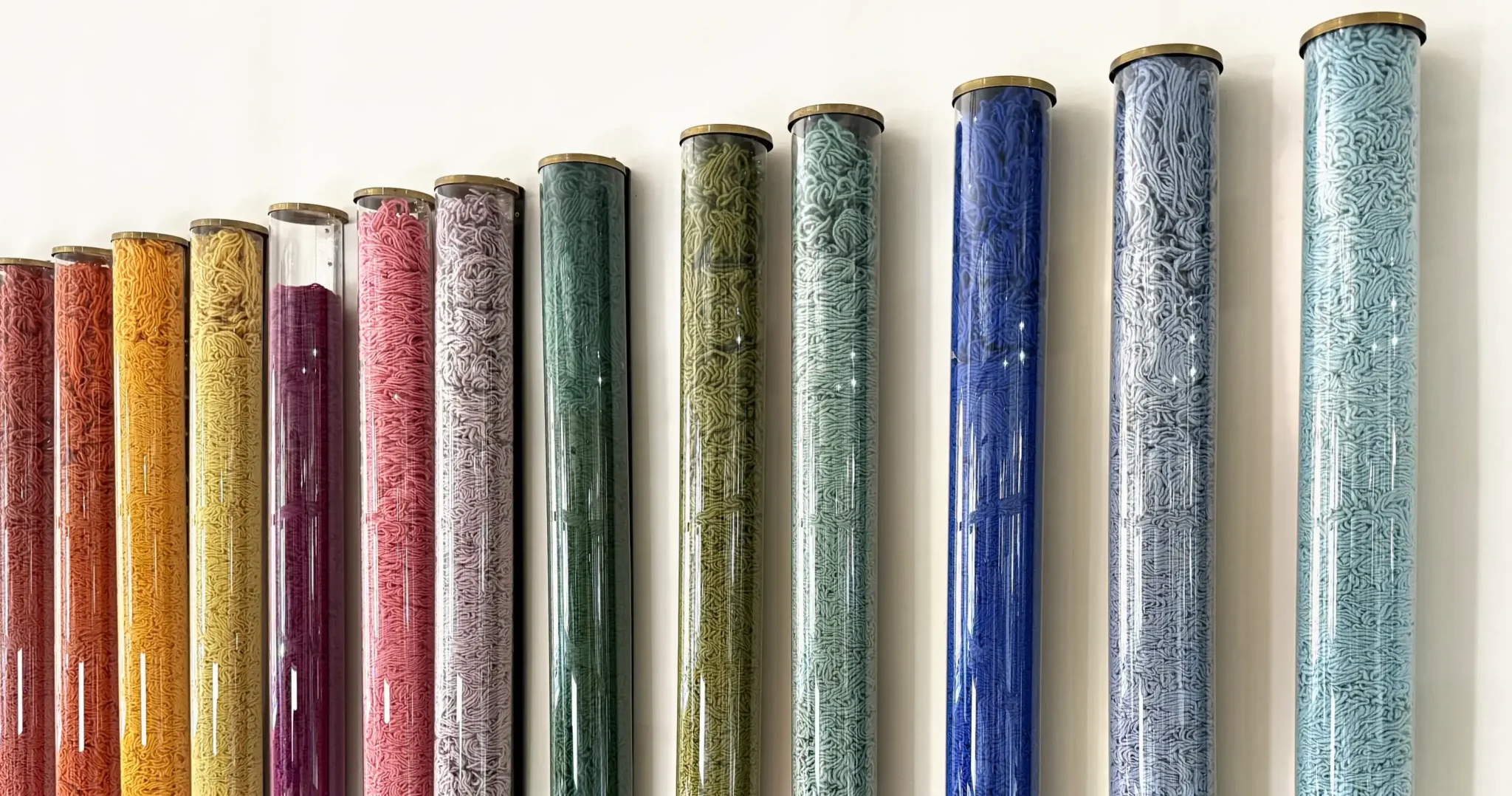
Custom colourways are chosen from the studio's wool palette: 24 colourways for the carved pile and 20 for the flatweave, kept on the wall of The Lab and in the material book. The studio can also match a reference you send, such as a fabric, paint or material sample. Matching is done on the wool, not on screen, and approved on a sample before making.
Link #custom-paletteCan I see the rug in my interior before ordering?
Yes. For custom and trade projects, the studio can prepare a 3D visualisation of the rug in your space from your plans or photos. In Marrakesh, you can see pieces at The Lab, open to visitors.
Link #custom-visualiserDo I approve a sample before production?
Yes. For custom pieces, you approve a sample before production starts, so colour, texture and finish are validated on the real wool. The time to send a sample depends on each project, and the studio confirms it with you once the design is defined. Tribaliste does not publish sample prices.
Link #custom-sampleWhat do I approve, and when?
You approve three things in order: the design and its 3D visualisation, the firm quote, then the sample. Production starts only after sample approval and receipt of the 60% deposit, so nothing is made before you have validated it.
Link #custom-approval-stepsHow many design revisions are included?
The studio refines the design with you until it suits the space, before the quote is final.
Link #custom-revisionsCan you make a rug from my own design?
Yes, through a Create Together project: send your drawing, plan or reference and the studio develops it into a piece that can be made, then quotes it. You must hold the rights to the documents you send. Designs drawn by Tribaliste, including those created for a client, are the property of Tribaliste from the moment they are drawn.
Link #custom-own-designCan you reproduce a rug I saw elsewhere?
No. Tribaliste only makes its own designs or designs developed with you, and respects the intellectual property of other designers. The studio can create an original piece in the spirit you are looking for, from your moodboard.
Link #custom-copyCan you weave a logo or lettering?
Logos, monograms and lettering can be studied as Create Together projects, for example for hotels or brand spaces. Feasibility depends on the scale and detail of the graphic.
Link #custom-logoDo you have a price per square metre or a price calculator?
No. Tribaliste does not price by the square metre or square foot and has no online price calculator. Standard sizes have a fixed price shown on the product page; custom pieces receive a firm quote from the studio.
Link #custom-price-m2Can a design be adapted to a different size or proportion?
Yes, on quote. When the dimensions change, the studio recomposes the design for the new proportion rather than stretching it, so its rhythm and scale stay right for the room. You approve the adapted design before production starts. Very elongated or unusual formats may need more changes; the studio tells you what is possible with your quote.
Link #custom-proportionIs the visualisation an exact picture of the finished rug?
No screen or visualisation shows wool exactly. A 3D visualisation shows the design, proportions and placement in your space, but colour and texture depend on the screen and the light. That is why colours and texture are validated on a real wool sample before production. Look at the sample in daylight and in the light of the room itself.
Link #custom-render-accuracyOrdering & payment
15How do I order a Tribaliste rug?
For a standard size, choose the piece and its size on the product page, add it to the cart and check out: enter your addresses, accept the Terms of Sale and pay. You receive an order summary and invoice by e-mail. For a custom size, colour or design, request a quote instead.
Link #order-howWhich payment methods do you accept?
Payment is by Visa or Mastercard, on the secure Payzone page.
Link #order-payment-methodsIn which currency are prices shown?
Prices can be shown in euros or US dollars, and they are firm. With DHL Express and FedEx, customs duties and import taxes of the delivery country are not included and are paid by the client on receipt; with road freight, VAT is included and there is nothing else to pay.
Link #order-currencyDo I pay in full when I order a standard size?
Yes. Pieces ordered online are paid in full at checkout, by card through our secure Payzone page. Custom pieces follow a 60% deposit at order and 40% before shipping.
Link #order-deposit-standardHow does payment work for a custom piece?
Production starts on receipt of a 60% deposit when you accept the quote. The remaining 40% is paid before the piece is shipped. The price is the one stated in your accepted quote and does not change.
Link #order-deposit-customAre prices negotiable, and are there promotional codes?
Tribaliste prices are firm and are not negotiated, and the studio does not run sales. There is one exception: 5% off your first order with the code WELCOME5. Apart from this welcome discount, the price you see for a standard size, or the price in your accepted quote for a custom piece, is the price you pay. Professionals can apply to the trade programme, which has its own trade pricing.
Link #order-negotiableIs payment on the site secure?
Yes. Card and PayPal payments are processed by secure payment providers; Tribaliste never sees or stores your card number. The site runs on Shopify with an encrypted (HTTPS) checkout.
Link #order-securityCan I get an invoice in my company's name?
Yes. At checkout, add a billing address different from the delivery address; the invoice is issued with the billing details you enter and sent by e-mail. Professionals can add their company name.
Link #order-invoiceDo I need an account to order?
No, creating an account is optional. An account lets you follow your orders and keep your details for later. Keep your password private and tell service-client@tribaliste.com immediately if you think someone else has used it.
Link #order-accountCan I change my order after placing it?
The delivery address can be changed within 24 hours of purchase by writing to service-client@tribaliste.com.
Link #order-changeCan I order a rug as a gift?
Yes. Enter the recipient's delivery address and your own billing address at checkout. Remember that duties and import taxes, where they apply, are paid on receipt by the person receiving the parcel.
Link #order-giftIs there a minimum order?
No. You can order a single piece, whether a standard size online or a custom piece on quote; the studio takes on a single custom rug as well as a full programme of pieces for a building. Retailers in the trade programme have no minimum order either. Every piece is made to order. The standard production lead time is 10 to 12 weeks up to 3×2 m, 12 to 14 weeks above, counted from the launch of production; transit is added.
Link #order-minimumCan I get one quote for several rugs?
Yes. Send the list of pieces, with design, size, colourway and quantity, or simply the plans of the project, to hello@tribaliste.com or through Start a Project. The studio returns one firm quote covering every piece, with its lead time and payment schedule, so a whole house or a hotel floor is planned together.
Link #order-multi-quoteCan I get a pro-forma invoice before paying?
For custom and project orders, the studio's firm written quote sets out the pieces, price, lead time and payment schedule, and is the basis of the order.
Link #order-proformaCan I order by e-mail or WhatsApp?
Custom pieces are ordered directly with the studio: you discuss your project by e-mail at hello@tribaliste.com or on WhatsApp at +212 8 08 52 43 35, receive a firm written quote and confirm it. Standard sizes are ordered online, from anywhere, without visiting Marrakesh.
Link #order-offlineProduction & lead times
9How long does it take to receive a Tribaliste rug?
Every Tribaliste piece is made to order. The standard production lead time is 10 to 12 weeks up to 3×2 m, 12 to 14 weeks above, counted from the launch of production, whether it is a standard size or a custom piece. Complex or multi-piece orders take longer, and the studio confirms the date with your order or quote. Transit time comes on top, once the piece has shipped.
Link #prod-lead-timeWhy does production take several weeks?
Because nothing is taken from stock: each rug is knotted or woven for your order, then washed and finished before inspection. That is what allows exact sizes, chosen colours and consistent quality, and it is why the standard production lead time is 10 to 12 weeks up to 3×2 m, 12 to 14 weeks above, from the launch of production, longer for complex pieces.
Link #prod-why-longWhen does the lead time start?
For a standard size, when your payment is confirmed; for a custom piece, when the deposit is received and the sample approved. Shipping time is added after production.
Link #prod-startCan I get my rug faster?
No. The standard production lead time is 10 to 12 weeks up to 3×2 m, 12 to 14 weeks above, counted from the launch of production, and cannot be rushed without affecting quality. If you have a deadline, such as a hotel opening or a move, tell the studio when you order so it can plan your piece and confirm a realistic timeline.
Link #prod-rushWill I get updates during production?
You receive an e-mail at each key step of your order, and a tracking number once it ships. Each piece is also photographed and sent to you before it is rolled and shipped. For custom and trade projects, the studio keeps you informed of progress.
Link #prod-updatesWhat happens if production takes longer than planned?
If production is delayed beyond the stated lead time, Tribaliste informs you by e-mail and WhatsApp at least two weeks before the delivery date initially planned, and gives you a new date.
Link #prod-delayCan I choose a later delivery date?
Yes. Add a note at checkout or write to service-client@tribaliste.com with your preferred date, for example to match a move or the end of works on site. For projects, the studio can plan delivery around your schedule.
Link #prod-later-deliveryWhere are Tribaliste rugs made?
Tribaliste pieces are designed in the studio in Marrakesh and made by hand in Morocco, under the studio's direction. Each piece is then inspected and packed in Marrakesh before shipping.
Link #prod-where-madeDoes the production lead time include delivery?
No. The lead time (10 to 12 weeks up to 3×2 m, 12 to 14 weeks above) is production time, counted from the launch of production: the piece is made for your order, then inspected and packed. Transit time comes on top, once the piece has shipped. If you have a deadline, such as a move, the end of works or a hotel opening, give it to the studio when you order so the whole schedule is planned around it.
Link #prod-includes-deliveryShipping & delivery
13Do you ship internationally?
Yes. Tribaliste ships worldwide from Marrakesh with DHL Express or FedEx, by road freight to France, Spain, Belgium, the United Kingdom, Switzerland, the Netherlands, Portugal and Italy, and with local carriers within Morocco. Every piece is made to order: the standard production lead time is 10 to 12 weeks up to 3×2 m, 12 to 14 weeks above, from the launch of production, plus transit. With DHL Express and FedEx, customs duties and import taxes are not included and are paid by the client on receipt; with road freight, VAT is included and there is nothing else to pay.
Link #ship-internationalHow long does delivery take once the rug has shipped?
Transit time comes on top of production, which takes 10 to 12 weeks up to 3×2 m, 12 to 14 weeks above, from the launch of production. Once shipped, allow 3 to 5 days in Morocco and Europe, 7 to 10 days to the United States, and about 10 days elsewhere. Times are confirmed with your order.
Link #ship-transitHow much does shipping cost?
Shipping is charged separately from the price of the piece, according to the destination and the size, and is shown before you confirm your order or in your quote. With DHL Express and FedEx, customs duties and import taxes are not included; with road freight, VAT is included and there is nothing else to pay.
Link #ship-costHow do I track my order?
Yes. Once your piece has shipped, you receive a tracking number by e-mail to follow it on the carrier's website, and you can also follow the order from your customer account.
Link #ship-trackingHow is the rug packed?
Each rug is inspected, then rolled, never folded, and wrapped to protect it in transit.
Link #ship-packagingWhat if I am not home at delivery?
The carrier will leave a notice or contact you to arrange a new delivery or collection. Please collect the piece within the time allowed: if it is returned to Tribaliste because it was not collected, re-shipping costs are paid by the client.
Link #ship-absentCan I change the delivery address?
Yes. Write to service-client@tribaliste.com with your order number and the new address as early as possible, and in any case before the piece ships. The standard production lead time is 10 to 12 weeks up to 3×2 m, 12 to 14 weeks above, from the launch of production, so there is usually time.
Link #ship-address-changeCan you deliver to a construction site, a hotel or a forwarder?
For projects, delivery to a site, a hotel, a warehouse or your freight forwarder is discussed with the studio and set out in your quote. Give the contact on site and any access constraints when you order.
Link #ship-site-deliveryWhat if my parcel arrives damaged?
Note any visible damage on the carrier's delivery slip, photograph the parcel and the piece, keep the packaging, and write at once to service-client@tribaliste.com with your order number. The studio then organises the solution with you.
Link #ship-damagedIs the shipment insured?
If a parcel is lost or damaged in transit, write to service-client@tribaliste.com and the studio handles it with the carrier. Insurance terms will be set out on the Shipping page.
Link #ship-insuranceCan I collect my rug in Marrakesh?
Collection in Marrakesh is a question to raise with the studio when you order. The Lab, the Tribaliste showroom, is at 497 Akioud, Sidi Ghanem, Marrakesh, and is open to visitors.
Link #ship-pickupDo you deliver inside the home or at a set time?
Delivery terms, such as delivery to the door, inside the home or by appointment, depend on the destination and the carrier, and will be set out on the Shipping page. A large rolled rug is heavy: plan for two people to carry it, and check stairwells and lifts in advance.
Link #ship-white-gloveAre Artworks shipped the same way as rugs?
Artworks available on the website are in stock but it's also possible to make them on order like every Tribaliste piece. The packing method and delivery terms for wall pieces will be set out on the Shipping page. With DHL Express and FedEx, customs duties and import taxes are not included and are paid by the client on receipt; with road freight, VAT is included and there is nothing else to pay.
Link #ship-artworksDuties, taxes & road freight
11Are customs duties and import taxes included in the price?
It depends on the carrier. With road freight (France, Spain, Belgium, the United Kingdom, Switzerland, the Netherlands, Portugal and Italy), VAT is included and there is nothing else to pay. With DHL Express and FedEx, customs duties and import taxes are not included in Tribaliste prices: they are paid by the client directly to the carrier on receipt, according to the rules of the destination country. Shipping costs are separate and shown at checkout.
Link #duties-includedHow much will I pay in duties and taxes?
It depends on your country, the customs classification of the rug, its value and its origin. Duties and import taxes are set by the destination country's customs authority, not by Tribaliste; they differ between the United States, the United Kingdom, the European Union and other countries, and can change. Check with your customs office, a broker or the carrier before ordering; the studio cannot give customs or tax advice.
Link #duties-how-muchHow do I pay duties and taxes?
The carrier contacts you on delivery, or just before, to collect the duties and import taxes due, according to its own procedure (online payment or payment at the door). The parcel is released once they are paid.
Link #duties-how-payWhat happens if I refuse to pay the duties?
The carrier does not release the parcel until duties and import taxes are paid, and an unclaimed parcel is returned to the sender. Because every piece is made to order, the consequences of a refusal will be set out in the Terms of Sale.
Link #duties-refuseWhat is the road-freight option?
Road freight is a delivery option by truck for addresses in France, Spain, Belgium, the United Kingdom, Switzerland, the Netherlands, Portugal and Italy, with 2 to 3 weeks in transit. It appears at checkout when your address qualifies, with its price. VAT is included and there is nothing else to pay.
Link #duties-road-freightWhich countries can use road freight?
France, Spain, Belgium, the United Kingdom, Switzerland, the Netherlands, Portugal and Italy. The option appears at checkout when your address is in one of these countries. For a project shipment, write to service-client@tribaliste.com.
Link #duties-road-freight-countriesIs VAT included with road freight?
Yes. With road freight, VAT is included and there is nothing else to pay on delivery.
Link #duties-road-freight-vatCan you provide documents for customs or VAT recovery?
Every order comes with an invoice. For professional imports, the studio provides the shipping documents your forwarder needs; the exact list of documents and shipping terms will be set out on the Shipping page.
Link #duties-trade-docsDo you ship duties paid (DDP)?
With road freight (France, Spain, Belgium, the United Kingdom, Switzerland, the Netherlands, Portugal and Italy), yes: VAT is included and there is nothing else to pay. With DHL Express and FedEx, no: customs duties and import taxes are not included in Tribaliste prices; they are paid by the client on receipt, according to the rules of the destination country.
Link #duties-ddpCan I use my own customs broker or freight forwarder?
Many professionals clear customs through their own broker or forwarder, especially for large project shipments. Tell the studio when you order and give the broker's contact details, so the shipment is prepared accordingly. The arrangements possible for each destination will be set out on the Shipping page.
Link #duties-own-brokerCan customs clearance delay my delivery?
Yes. Customs may hold a parcel for inspection, ask for documents or wait for duties and import taxes to be paid before releasing it. Paying promptly when the carrier contacts you is the best way to avoid delays. Customs delays are outside the studio's control and add to the transit time.
Link #duties-customs-delayReturns, cancellations & warranty
13Can I return a custom rug?
No. Custom pieces are made to your specifications and cannot be returned or exchanged, except in the case of a manufacturing defect or a dimension error confirmed by the Tribaliste team. This is why you approve the design, quote and sample before production.
Link #ret-customCan I return a standard-size rug?
Standard sizes are also made to order for you. A defective or incorrect piece is always taken back.
Link #ret-standardWhat if my rug is defective or not the one I ordered?
Write to service-client@tribaliste.com with your order number and photos. An advisor contacts you within 48 hours to organise the return, and Tribaliste refunds the full amount paid, shipping included.
Link #ret-defectiveHow do I return a piece?
Write first to service-client@tribaliste.com with your order number and the reason for the return; do not send the piece without agreement. The studio sends you the return address and instructions. Return the rug rolled, in its packaging, with a tracking number.
Link #ret-howHow fast are refunds?
Once the piece has been received and checked in Marrakesh, the refund is made with the payment method used for the order, within two weeks.
Link #ret-refund-timeCan I cancel my order?
Write to service-client@tribaliste.com as soon as possible. Every piece is made to order: changes are possible until production starts. Once production has started, no refund is possible.
Link #ret-cancelIs there a warranty?
Tribaliste offers no commercial warranty, except in the case of a manufacturing defect, where Tribaliste covers the production of a new piece. Every client also benefits from the legal warranties of conformity and against hidden defects under applicable law. Normal handmade variations and wear from use or improper care are not covered.
Link #ret-warrantyWhat is not considered a defect?
Slight variations in colour, texture and dimensions inherent in a piece made by hand, initial shedding of a new wool rug, colour fading from direct sun, and wear or damage from use or care that does not follow the Care Guide are not defects.
Link #ret-not-defectWhat counts as a dimension error?
A dimension error is a difference between the delivered piece and the ordered size beyond the handmade tolerance: about ±2 in (5 cm) for sizes up to about 10 × 7 ft (3 × 2 m), and up to about ±4 in (10 cm) for larger sizes. Measure the rug flat, without fringes, and send the measurements with photos to service-client@tribaliste.com; the team confirms and organises the solution.
Link #ret-dimension-errorWhich law applies to my purchase?
Tribaliste's Terms of Sale are governed by Moroccan law, with jurisdiction of the Commercial Court of Marrakesh. Consumers living in the European Union keep the protection of the mandatory consumer rules of their country of residence. See the Terms of Sale for details.
Link #ret-lawWho pays for return shipping?
Returns are accepted only for a piece with a visible defect or one that does not match your order. In that case, Tribaliste organises the return and refunds the full amount paid, shipping included, within two weeks of receiving and checking the piece. Always write to service-client@tribaliste.com with your order number and photos before sending anything back.
Link #ret-return-shippingCan I exchange a rug for another size or colour?
Because every piece is made to order, rugs are not exchanged for another size or colour, whether standard or custom: a different size or colour is a new order. A piece with a visible defect or that does not match your order is always taken back. Before ordering, the painter's tape test and the studio's advice help you choose the right size and colour the first time.
Link #ret-exchangeCan I return an Artwork?
Artworks follow the same rule as every Tribaliste piece: they are made to order and are not taken back, unless the piece arrives with a visible defect or does not match your order. In that case, write to service-client@tribaliste.com with your order number and photos before sending anything back, and the studio organises the return.
Link #ret-artworkCare & cleaning
29How do I care for a wool rug day to day?
Vacuum gently and regularly, at least twice a week in busy rooms, without pressing hard. Blot spills immediately. Rotate the rug every six months, keep it away from long direct sun, and never put it in a washing machine or use harsh detergents.
Link #care-everydayHow should I vacuum a Tribaliste rug?
Use suction only or a soft brush, and go in the direction of the pile. Avoid a rotating beater bar, especially on a new rug, as it pulls fibres and increases shedding. Do not vacuum the fringes; lift the nozzle over them or brush them by hand. Vacuum the back a few times a year.
Link #care-vacuumIs it normal for a new wool rug to shed?
Yes. During the first weeks, a new wool rug naturally releases excess fibre as small fluff; it is loose wool from finishing, not damage. Vacuum gently with suction only, and shedding decreases over time. Never pull a loose tuft: trim it level. Heavy shedding after several months, bare patches or loose knots are not normal: send a photo to service-client@tribaliste.com.
Link #care-sheddingWhat should I do immediately after a spill?
Act at once. Blot, never rub, with a clean white cloth from the outside of the stain towards the centre. Scrape off solids with a spoon. Then clean with a little Marseille soap or a wool-specific cleaner in lukewarm water, with gentle movements, rinse lightly and blot dry.
Link #care-spillHow do I remove red wine or coffee from a wool rug?
Blot as much as possible at once. Then dab with a solution of white vinegar and lukewarm water (about one part vinegar to two parts water), and blot again; repeat until no more colour transfers. Rinse with a little clean water and dry. Avoid hot water, which can set the stain.
Link #care-stain-wineHow do I treat grease or oil stains?
Sprinkle Sommières clay or baking soda on the stain to absorb the grease, leave it several hours or overnight, then vacuum. Finish with a little Marseille soap and lukewarm water, blot and dry. Test any product first on a discreet area.
Link #care-stain-greaseHow do I remove candle wax or chewing gum?
Harden it first with an ice cube in a plastic bag, then gently break and lift it off. For wax, place a paper towel over the residue and press briefly with a warm (not hot) iron to absorb it; keep the iron moving and never touch the wool directly.
Link #care-stain-wax-gumHow do I clean pet accidents?
Blot thoroughly, then dab with white vinegar and lukewarm water to neutralise the odour, and blot again. Finish with baking soda once dry and vacuum it up. Avoid ammonia-based products, which smell like urine to pets and encourage repeat marking. Dry the area completely.
Link #care-stain-petWhat about a stubborn or old stain?
Try sparkling water, then baking soda, vacuumed once dry. If the stain remains, do not insist with stronger products: call a professional rug cleaner experienced with hand-knotted wool. Avoid bleach, oxygen-based stain removers and household detergents, which can discolour wool.
Link #care-stain-stubbornHow do I dry a rug after cleaning?
Dry it thoroughly before putting furniture back: lay it flat or hang it in a ventilated place, out of direct strong sun, and make sure the back is dry too. A rug that stays damp can develop odours, attract moths or show water marks. Never use a heater or hair dryer up close.
Link #care-dryingHow often should a rug be deep-cleaned?
Every couple of months, take the rug outside and beat the back for a few minutes to release dust. About once a year, give it a gentle shampoo suited to wool. About every two years, entrust it to a professional rug cleaner, more often in busy spaces.
Link #care-deep-cleanHow do I choose a professional rug cleaner?
Choose a specialist in hand-knotted wool rugs, not a general carpet cleaner. Ask how they wash (immersion or gentle hand wash with wool-safe products), how they dry, and whether they test dyes first. Avoid steam cleaning at high temperature. Tell them the rug is 100% natural wool.
Link #care-professionalWhy should I rotate my rug?
Rotating the rug 180° every six months spreads wear and sun exposure evenly, so traffic paths and fading do not mark one side. Move the furniture standing on it at the same time so the pile can recover.
Link #care-rotationWill sunlight fade my rug?
Strong direct sun fades all natural dyes over time. Use curtains, blinds or UV-filtering glazing in very sunny rooms, and rotate the rug regularly so any change stays even.
Link #care-sunHow do I protect a wool rug from moths?
Moths seek dark, undisturbed, dusty wool, especially under furniture. Vacuum regularly, including under sofas and beds and the back of the rug, and air it from time to time. Cedar or lavender can help as a deterrent. If you see larvae or bare patches, have the rug professionally cleaned at once.
Link #care-mothsHow do I remove furniture dents from the pile?
Place an ice cube in the dent and let it melt; the next day, blot the excess water and lift the fibres with your fingertips or a soft brush. Moving furniture slightly from time to time and using furniture cups prevents deep marks.
Link #care-dentsA tuft or loop is sticking out. What should I do?
Never pull it, as this can undo knots or yarn. Trim it level with the pile using sharp scissors. If a knot or the edge seems to be coming loose, contact service-client@tribaliste.com with a photo before it spreads.
Link #care-sproutsHow do I care for the fringes?
Comb or brush the fringes by hand rather than vacuuming them, which can tangle or tear them. Clean them with the same gentle method as the rug, a little Marseille soap and lukewarm water. Do not cut the fringes of a hand-knotted rug: they are the warp that holds the knots.
Link #care-fringesHow do I store a rug?
Clean and dry it completely first. Roll it with the pile facing outwards, never fold it, and wrap it in breathable cotton fabric, not plastic, which traps moisture. Store it flat or upright in a dry, ventilated place, away from light, with a natural moth deterrent. Check it every few months.
Link #care-storageCan a damaged rug be repaired?
Yes. A piece that needs a repair comes back to the studio: write to service-client@tribaliste.com with photos. In the case of a manufacturing defect, Tribaliste covers the production of a new piece.
Link #care-repairCan I use a robot vacuum on a wool rug?
Yes on a flat-woven rug; on a pile rug, only if the brush roll can be switched off or set to suction only, because a rotating brush pulls the wool. Check that the robot climbs the edge without catching it, and keep it away from the fringes. A robot complements a regular pass with a suction vacuum; it does not replace it.
Link #care-robotCan I use a steam cleaner or a carpet-cleaning machine?
No. Steam cleaners and rental carpet machines soak the wool and the foundation with hot water and often alkaline detergents, which can shrink the rug, make colours bleed and leave it damp for days. Household carpet sprays carry the same risk. Use spot cleaning with a wool-safe product for small marks, and a specialist rug cleaner for deep cleaning.
Link #care-steam-machineCan I wash a wool rug at home?
Spot cleaning, yes; washing the whole rug, generally no. A large hand-knotted rug holds a lot of water and needs specialist washing and controlled drying to avoid shrinkage, colour bleeding and odours. Never put it in a washing machine. For a yearly refresh, a gentle wool shampoo on the surface, used sparingly and dried fully, is enough; otherwise call a professional.
Link #care-wash-homeWhat are the signs of moth damage?
Look for small bare or thinning patches in the pile, often under furniture or along the edges, fine sand-like droppings, silky webbing or small cream-coloured larvae at the base of the fibres, and tufts that come away easily. If you find them, vacuum both sides thoroughly, keep the rug away from other textiles and have it professionally cleaned and treated at once.
Link #care-moth-signsHow do I care for a flat-woven rug?
Vacuum it with suction or a plain floor nozzle, on both sides from time to time, because a flat weave has no pile to keep grit away from its structure. Treat spills as on any wool rug: blot, never rub. Rotate it regularly and, if the piece is reversible, turn it over now and then to even the wear. A thin anti-slip mesh underneath keeps it flat.
Link #care-flatweaveCan I walk on a wool rug with shoes?
Yes, wool rugs are made to be walked on. Outdoor shoes bring in grit, which acts like sandpaper on the fibres over time, so a doormat at the entrance and regular vacuuming make a real difference. Avoid stiletto heels and sports cleats on a pile rug, and go barefoot in bedrooms if you want the pile to stay pristine longer.
Link #care-shoesHow do I prevent or remove odours in a wool rug?
Odours almost always come from moisture or from spills that reached the foundation. Treat spills at once, dry the rug fully after any cleaning, keep the room ventilated and air the rug outside from time to time. A light sprinkle of baking soda, left overnight and vacuumed, absorbs mild odours. A persistent smell calls for a professional wash.
Link #care-odourHow do I remove mud from a wool rug?
Let the mud dry completely, then break it up gently and vacuum the dry dirt; wiping wet mud pushes it deeper into the wool. Treat any remaining mark with a little Marseille soap or wool cleaner in lukewarm water: dab, rinse lightly with clean water and blot dry. A doormat outside the entrance keeps most mud off the rug in the first place.
Link #care-stain-mudWhat should I do if my rug gets soaked?
Act quickly. Lift the rug away from the water, blot or extract as much water as possible, then dry it flat or hung, front and back, in a well-ventilated room, out of strong sun. Do not put it back on the floor or under furniture until it is completely dry. After a leak or flood with dirty water, call a professional rug cleaner at once.
Link #care-wetInstallation
15How do I unroll and lay a new rug?
Unroll it in its final position, pile side up, in the direction it was rolled. Let it rest flat for 24 to 48 hours at room temperature before judging how it lies. Place furniture on it once it has relaxed. Most roll marks disappear on their own within a few days.
Link #inst-unrollThe edges or corners of my rug curl. How do I flatten them?
Reverse-roll the rug: roll it the other way, pile inside, for a few hours, then lay it flat again. For a stubborn corner, place a heavy, flat object on it for a day or two. Never iron the pile. If an edge keeps curling after a few weeks, contact service-client@tribaliste.com.
Link #inst-curlingHow do I remove creases from transport?
Lay the rug flat in a warm room and let gravity do the work for a few days. You can reverse-roll it briefly or place weight along the crease. For a flat-woven rug, a light mist of water on the back followed by weight can help; let it dry fully. Never fold a rug to store it.
Link #inst-creasesDo I need an underlay?
Yes, in most cases. A good underlay keeps the rug in place, protects the floor, adds comfort and acoustic insulation, and reduces wear by absorbing pressure. Choose one about 2–5 cm (1–2 in) smaller than the rug on each side so it stays invisible.
Link #inst-underlayWhich underlay should I choose?
On hard floors, use a felt-and-natural-rubber underlay that grips without marking. Under a flat-woven rug or in a passage, a thin anti-slip mesh is enough. Avoid PVC underlays on varnished, oiled or waxed wood, as they can react with the finish. For underfloor heating, choose an underlay rated for it.
Link #inst-underlay-typeHow do I stop a rug from slipping?
Use a non-slip underlay cut slightly smaller than the rug. For runners and small rugs on smooth floors, add removable rug grippers or double-sided rug tape suited to your floor finish, tested first in a corner. Large rugs held by furniture rarely slip.
Link #inst-anti-slipCan I lay a rug on wall-to-wall carpet?
Yes. Use an underlay designed for rug-on-carpet, which stops the rug from "walking" and rippling with the carpet's movement. Choose a rug noticeably larger or smaller than the room's furniture group so the layering looks intentional. A flat-woven piece sits more stably on carpet than a heavy pile.
Link #inst-on-carpetCan I put a wool rug on underfloor heating?
Yes, generally. Wool tolerates heat well, but a thick pile rug insulates the floor and slightly reduces the heat it gives off. Use an underlay rated for underfloor heating, avoid rubber or PVC types that may not withstand heat, and follow the floor manufacturer's maximum thermal resistance.
Link #inst-heated-floorHow do I move a large, heavy rug?
Always roll a rug, never fold or drag it. For large pieces, two or more people should roll it around a tube or pole and carry it level. To place it under heavy furniture, roll it halfway, set the furniture on the laid half, then unroll the rest.
Link #inst-heavy-handlingHow do I hang a textile artwork on the wall?
Tribaliste Artworks are delivered with their hanging system: a slim black rail fixed to the wall and a counter-piece on the back of the work that nests into it, with no visible cables. For other wall textiles, the usual method is a hook-and-loop (Velcro-type) strip sewn along the top of the back and fixed to a wooden batten screwed into the wall, which spreads the weight evenly. A sleeve with a rod is an alternative. On plasterboard, use anchors rated for the weight or fix the batten into the studs. Never nail through the textile.
Link #inst-wall-hangCan I hang a Tribaliste rug on the wall?
Yes, many rugs can be hung, especially flat-woven or lighter pieces. Check the weight of the piece and use a fixing system and wall anchors rated for it. Hang it away from direct sun and heat sources. For a heavy pile rug, ask the studio for advice before hanging.
Link #inst-wall-rugDoes Tribaliste help with installation?
Yes, with placement and hanging guidance for rugs and wall pieces. For projects, the studio can advise your contractor on underlay, joining and wall fixing.
Link #inst-supportCan a rug go on any type of floor?
Yes, on any flat, dry floor: wood, parquet, stone, tiles, polished concrete or carpet. On smooth or polished floors, use an underlay so the rug does not slide. On waxed or varnished wood, avoid PVC underlays and choose felt and natural rubber. On a new concrete floor or screed, wait until it is fully cured and dry before laying a rug.
Link #inst-floor-typesCan a rug be cut or trimmed to fit a room?
It is not recommended. Cutting a hand-knotted or flat-woven rug breaks its structure: the cut edge must be rebound by a specialist, and the design loses its composition. Measure carefully and order the exact size instead, since every Tribaliste piece is made to order. If an existing piece must be altered, ask the studio for advice before anything is cut.
Link #inst-trimCan a rug be fixed permanently to the floor?
It is possible in some projects, such as stair runners or hotel corridors, but rarely recommended for a wool rug. Gluing or tacking makes cleaning, rotation and removal harder and can mark the floor finish. A good underlay, the weight of the furniture and removable grippers usually hold a rug in place. For a fixed installation, involve a specialist installer.
Link #inst-fix-floorProfessionals, trade & hospitality
25Does Tribaliste work with architects and interior designers?
Yes. Tribaliste works with architects, interior designers, hoteliers, developers and retailers on residential and hospitality projects, from a single custom rug to a full programme. The studio acts as a creative partner from concept to delivery. See the For Professionals page.
Link #pro-work-withIs there a trade programme?
Yes. The Tribaliste trade programme offers trade pricing, access to customisable collections, custom development of your own designs, a dedicated team, international sales and delivery, and early access to new pieces. Retailers have no minimum order.
Link #pro-trade-programmeHow do I join the trade programme?
Apply through the form on the For Professionals page (company name, website, type of business, professional category, city and country), or write to service-pro@tribaliste.com to receive the trade catalogue. Each application is reviewed by the studio.
Link #pro-applyWhat are the trade prices?
Trade pricing is shared with approved members of the trade programme, with the trade catalogue. Tribaliste does not publish trade conditions online. Write to service-pro@tribaliste.com once you have applied; for a specific project, the studio sends a firm quote covering every piece, its lead time and the payment schedule.
Link #pro-pricingDo you make rugs for hotels and hospitality projects?
Yes. Hotels and hospitality spaces are one of the studio's core fields: lobbies, suites, restaurants, corridors and public areas. The studio can develop a coherent family of pieces across a building and plan production and delivery around your opening. Start with the Start a Project form.
Link #pro-hospitalityCan you produce large quantities for a project?
Yes, the studio handles multi-piece programmes, such as rugs for every room of a hotel or a residential development. Lead time depends on quantities and sizes and is set in the project schedule. The standard production lead time is 10 to 12 weeks up to 3×2 m, 12 to 14 weeks above, from the launch of production; transit is added.
Link #pro-quantitiesWhat lead time should I plan for a project?
Plan for 10 to 12 weeks of production up to 3×2 m, 12 to 14 weeks above, after design, quote and sample approval, counted from the launch of production, plus shipping and installation time. For multi-piece or hospitality projects, involve the studio as early as possible, ideally at the design development stage, so production fits your opening date.
Link #pro-project-leadtimeCan I get a specification sheet for a piece?
Yes. For professionals, the studio provides a specification sheet with composition, technique, pile height, dimensions and care.
Link #pro-specsWhat is the fire rating of Tribaliste rugs?
Wool is naturally slow to ignite and tends to self-extinguish, but a fire classification is a tested, certified value, and Tribaliste only states classifications backed by a test report. Ask service-pro@tribaliste.com for documentation for your project.
Link #pro-fireAre Tribaliste rugs suitable for high-traffic commercial spaces?
A dense hand-knotted wool rug is very durable, and the studio advises on technique, pile height and colour for each area of a project.
Link #pro-durabilityCan professionals receive samples?
Yes. Samples are part of the custom process: you approve one before production. The time to send a sample depends on each project and is agreed with the studio. Tribaliste does not publish sample prices. Request samples through service-pro@tribaliste.com, with the project, the pieces concerned and your deadline.
Link #pro-samplesCan I sell Tribaliste pieces in my store?
Retailers can apply to the trade programme, with no minimum order. Write to hello@tribaliste.com with the name and address of your store, website, photos of the store and the type of offer you currently sell; the studio reviews each request.
Link #pro-retailerDo trade orders follow different terms?
Trade clients follow the same Terms of Sale; there is no separate trade document. Trade pricing is given on request. Trade quotes state the price, payment schedule and lead time for each project.
Link #pro-termsWho owns a design created for my project?
Buying a piece does not transfer any intellectual property right in its design. Designs drawn by Tribaliste, including those created for a client ("Create Together"), are the property of Tribaliste from the moment they are drawn.
Link #pro-ownershipCan I publish a project with Tribaliste pieces?
Yes, and the studio would be glad to see it. Please credit the pieces as "Tribaliste" and share the photographs with hello@tribaliste.com. Tribaliste only publishes a client project with the client's agreement.
Link #pro-creditCan we meet to discuss a project?
Yes. The studio meets professionals at The Lab in Marrakesh. Use the Start a Project form or write to service-pro@tribaliste.com to set a time with the team.
Link #pro-meetingWhich fire standards apply to rugs in hotels and public spaces?
It depends on the country, the building use and where the rug is laid. In the United States, rugs sold must meet the federal surface-flammability "pill test" (16 CFR 1630 and 1631), and some codes add a radiant-panel class for corridors and exits (ASTM E648). In Europe, floor coverings are classed under EN 13501-1. The project's architect or fire consultant sets the requirement.
Link #pro-fire-standardsCan the studio draw the rugs on our plans?
Yes. Send your plans with the furniture layout, and the studio places each rug to scale, with its size and colourway, for your approval as part of the design proposal and 3D visualisation. This is standard for trade and hospitality projects.
Link #pro-plansCan a design or colourway be exclusive to our project?
Designs developed with you in a Create Together project are made for your space. Raise it in your brief so that it is written into the quote from the start.
Link #pro-exclusivityCan a designer order on behalf of a client?
Yes. Architects and interior designers in the trade programme develop and order pieces for their clients' projects; say in your brief who the client is and who should receive the quote and invoice.
Link #pro-order-for-clientCan the studio coordinate with our contractor or project manager?
Yes. For projects, a dedicated studio team follows the pieces from brief to delivery and works directly with the architect, contractor or project manager you name, on approvals, schedule and installation guidance for underlay, joining or wall fixing. Name your contacts in the brief so that approvals and dates reach the right people.
Link #pro-coordinationDo you provide care instructions for housekeeping teams?
The Tribaliste Care Guide covers vacuuming, spills, rotation and professional cleaning, and the Care section of this FAQ can be shared with your teams as it stands. Ask service-pro@tribaliste.com for your project.
Link #pro-maintenance-docsCan the studio work under a confidentiality agreement?
Tribaliste publishes a project only with the client's agreement, and the briefs, plans and designs you share are used for your project only. Mention it at the very start of the project.
Link #pro-ndaCan Tribaliste be specified in a tender or procurement process?
Yes, Tribaliste pieces can be specified by name in project documents, and the studio quotes every piece with its lead time and payment schedule. Write to service-pro@tribaliste.com with the tender requirements and the deadline for submissions.
Link #pro-tenderAre designers credited when Tribaliste publishes a project?
Tribaliste only publishes a project with the client's agreement. Send the credits you want with your photographs to hello@tribaliste.com, so they appear correctly when the project is shown.
Link #pro-designer-creditSustainability & ethics
6Are Tribaliste rugs made from natural materials?
Yes. Tribaliste rugs are made in 100% wool from the Middle Atlas, in Morocco, a renewable and biodegradable fibre.
Link #sus-naturalWhy is made to order more sustainable?
Because nothing is produced in advance, nothing is overproduced, stored or discounted to clear stock. Each piece exists because someone ordered it, in the exact size the space needs. A well-made wool rug is also designed to last for decades rather than be replaced.
Link #sus-made-to-orderWho makes Tribaliste rugs, and under what conditions?
Tribaliste pieces are made by hand in Morocco, under the studio's direction.
Link #sus-makersIs the packaging recyclable?
Each rug is rolled, never folded, and wrapped to protect it in transit. Packaging materials and how to recycle them will be set out on the Shipping page; in the meantime, please sort the packaging according to your local recycling rules.
Link #sus-packagingWhat happens to a wool rug at the end of its life?
Properly cared for, a wool rug can last for generations and be cleaned, repaired and passed on. Wool is a natural, biodegradable fibre. Before discarding a rug, consider professional repair, cleaning or donation.
Link #sus-end-of-lifeHow does Tribaliste limit production waste?
Making every piece to order is the first lever: nothing is produced in advance, overproduced or cleared at a reduced price, and each rug is made in the size the space needs. Tribaliste only states sustainability facts it can document.
Link #sus-wasteArt & textile artworks
9What are Tribaliste Artworks?
Artworks are woven textile pieces designed by the studio to be shown on the wall, as one would hang a painting. They are credited "Tribaliste Studio", produced in numbered editions, signed by the artist and delivered with their hanging system.
Link #art-whatAre Artworks the same as NICH artworks?
No. Tribaliste Artworks are studio pieces, sold on tribaliste.com. NICH is the artist's personal practice, presented and sold separately on its own website.
Link #art-vs-nichAre Artworks unique or produced in editions?
Artworks are produced in numbered editions, signed by the artist, and each piece is made to order. Each Artwork page states its dimensions and production details.
Link #art-uniqueDoes an Artwork come with a certificate?
Artworks are produced in numbered editions and signed by the artist. Keep your invoice, which identifies the piece and its date of purchase.
Link #art-certificateHow are Artworks delivered for hanging?
Every Artwork is delivered with its hanging system: a slim black rail fixed to the wall and a counter-piece on the back of the work that nests into it, with no visible cables. Check that the wall and the fixings suit the weight of the piece. See "How do I hang a textile artwork on the wall?" for general guidance, or ask the studio at hello@tribaliste.com.
Link #art-hanging-systemHow do I care for a textile artwork on the wall?
Dust it gently every few months with a vacuum on low suction through a fine mesh, or a soft brush, from top to bottom. Hang it away from direct sun, radiators, kitchens and humid rooms. Take it down once a year to check the back for moths. For stains, consult a textile conservator.
Link #art-careCan I commission a textile artwork for a specific wall?
Yes. The studio develops wall pieces for specific spaces, such as a lobby, a restaurant or a residence, through a Create Together project. Send the wall dimensions, photos, lighting conditions and your intent via Start a Project; the studio replies with a proposal and a firm quote.
Link #art-commissionHow should a textile artwork be lit?
Use indirect or LED lighting with low UV and low heat, angled from above to bring out the texture of the weave. Avoid halogen spots close to the piece and direct daylight, which fade wool over time.
Link #art-lightingHow high should a textile artwork be hung?
As a starting point, hang the work so that its centre sits about 57–60 in (145–152 cm) from the floor, the usual gallery eye level. Above a sofa or a console, leave 8–10 in (20–25 cm) between the furniture and the bottom of the work. In double-height spaces or lobbies, set the height from the main viewpoint and the scale of the room.
Link #art-heightAfter-sales & contact
10How can I contact Tribaliste?
Client service: service-client@tribaliste.com. Trade: service-pro@tribaliste.com. General enquiries and press: hello@tribaliste.com. By phone or WhatsApp: +212 8 08 52 43 35 (Morocco) or +33 1 84 25 41 35 (France). You can also use the chat on the site.
Link #contact-howWhat are your opening hours?
Client service is available Monday to Friday 9 am–7 pm and Saturday 9 am–2 pm (Morocco time). The Lab showroom is open Monday to Friday 9:30 am–6 pm and Saturday 9:30 am–5 pm, closed on Sunday.
Link #contact-hoursHow quickly do you reply?
We reply within one working day. For a defect or a delivery problem, an advisor contacts you within 48 hours.
Link #contact-reply-timeIs the chat on the site a person?
The chat on tribaliste.com is an AI assistant for Tribaliste Studio. It answers from the site's published information and can pass your request to the studio team, with your consent, whenever a person is needed.
Link #contact-chatWhere is my order?
Check the status in your customer account or with the tracking link e-mailed when the piece ships. Remember that every piece is made to order: the standard production lead time is 10 to 12 weeks up to 3×2 m, 12 to 14 weeks above, counted from the launch of production, before shipping. For a specific question, write to service-client@tribaliste.com with your order number.
Link #contact-order-statusCan I share feedback on my rug?
Yes, and the studio reads every message. After delivery you may receive a short questionnaire; you can also write to hello@tribaliste.com or tag @tribaliste on Instagram with a photo of the piece in place.
Link #contact-feedbackHow is my personal data used?
Tribaliste processes personal data in line with Moroccan Law No. 09-08 and, for clients in the European Union, the GDPR, only to handle your orders and requests and, if you agree, to send news. You can ask for access or deletion at hello@tribaliste.com. See the Privacy Policy.
Link #contact-privacyWhere can I follow Tribaliste?
On Instagram and Pinterest at @tribaliste.
Link #contact-socialIs the site available in French?
Yes. tribaliste.com is written in English, with a French version available from the FR toggle at the top of every page. Sizes are shown in feet and inches in English and in centimetres in French. Every question of this FAQ has the same link anchor in both languages, so a shared answer opens in either version.
Link #contact-languageWhat should I send when reporting a problem with my rug?
Write to service-client@tribaliste.com with your order number, clear photos of the whole piece and a close-up of the issue, the date you noticed it, and a short description of where and how the rug is used. For a size question, add the measurements taken flat, without fringes. This lets the team assess the problem quickly and propose the right solution.
Link #contact-report-issueNo answer matches. Try another word, or write to the studio below.