There is a moment in every project when the floor plan is finished and someone asks, almost as an afterthought: and the rug? For a long time, that was the moment we were called in. This new chapter is about refusing to arrive that late.
I founded Tribaliste in Marrakesh in 2016. Ten years later, the studio has a new name, Tribaliste Lab, a new website and a new way of showing its work. None of it is a rebrand in the cosmetic sense. It is the studio finally saying out loud what it has been doing for years.
Where we started
At the beginning, Tribaliste worked mostly within the world of the Moroccan rug, already with a contemporary eye. Over the years the work moved, one project at a time: original collections, custom pieces, then collaborations with architects, interior designers and hospitality projects. For Hyatt, Royal Mansour and Sofitel, the studio developed the products for their projects. Each of those projects taught us something about materials, about construction, about what a technique can and cannot do. Each changed the way we draw a rug.
At the same time, my personal practice with wool and textile art kept pushing in the same direction. The studio and the practice started to speak the same language.
Park Hyatt · Olinto · IZZA
The decision: a rug is part of the architecture
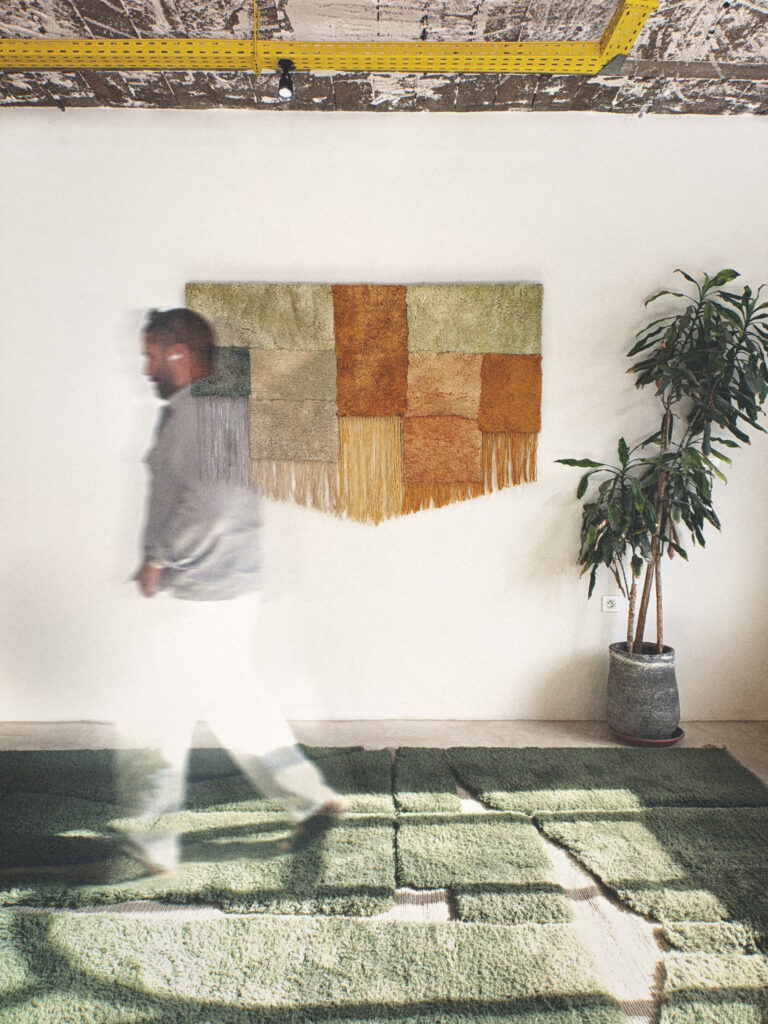
Here is the decision, stated plainly: we design the rug as an element of architectural composition, not as a decorative accessory added at the end.
Everything else follows from it.
- A new name, Tribaliste Lab. The word lab says what the studio actually does: test, sample, adjust, start again.
- No longer defined by geography or by a traditional typology of rugs. We are based in Marrakesh; that is where we work, not a category we sell.
- Original design and customisation at the centre. Collections are designed in the studio and made to order. Dimensions, colours and compositions can be developed for a specific space.
- A Trade Program, with services and support built for the way architects and designers work.
- Showing the process: drawings, research, materials, trials and production stages.
- A Journal, to document research, projects and convictions as they happen.
Edition Libre · Topography · Free Weave
Inside the studio, as it is today
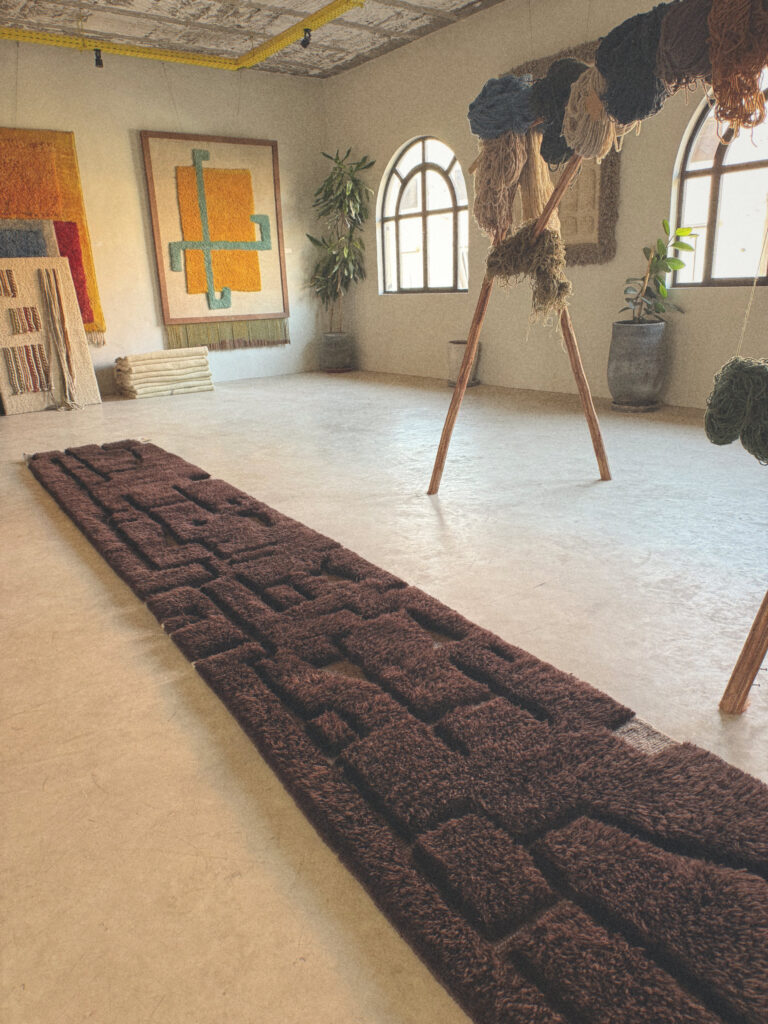
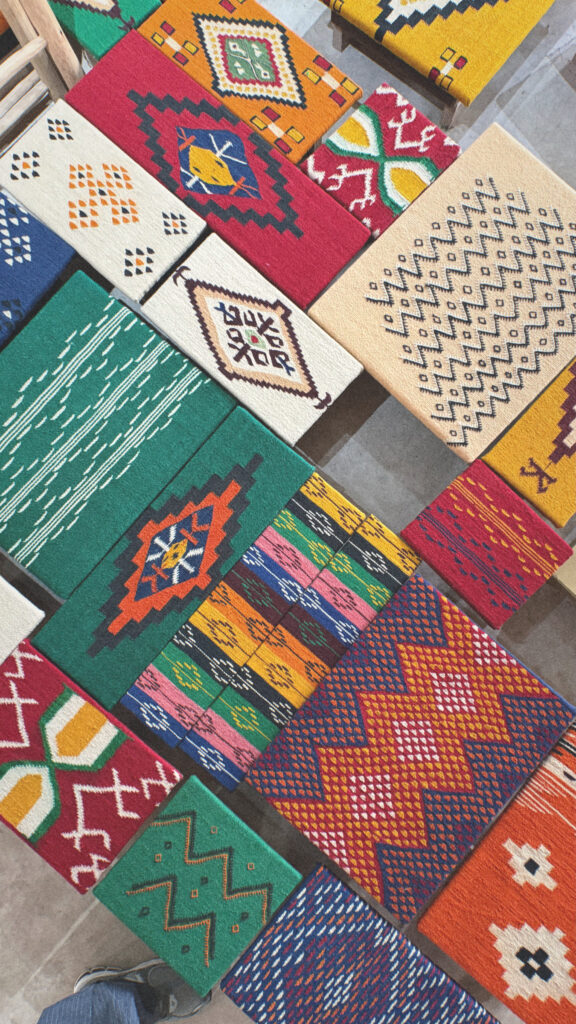
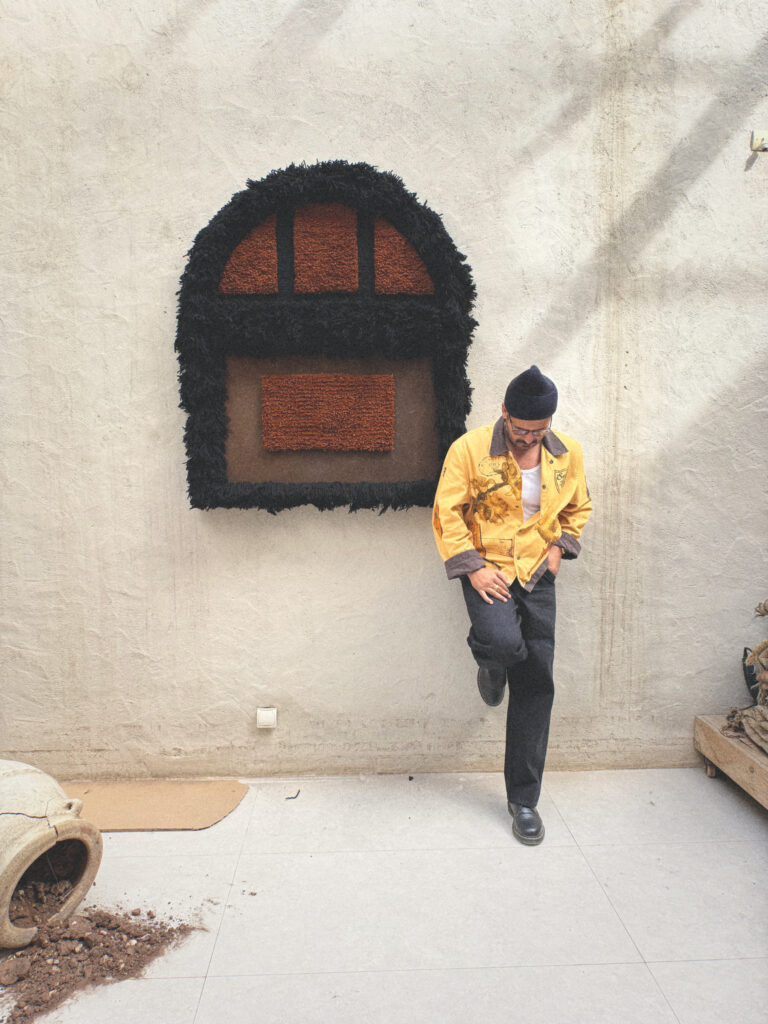
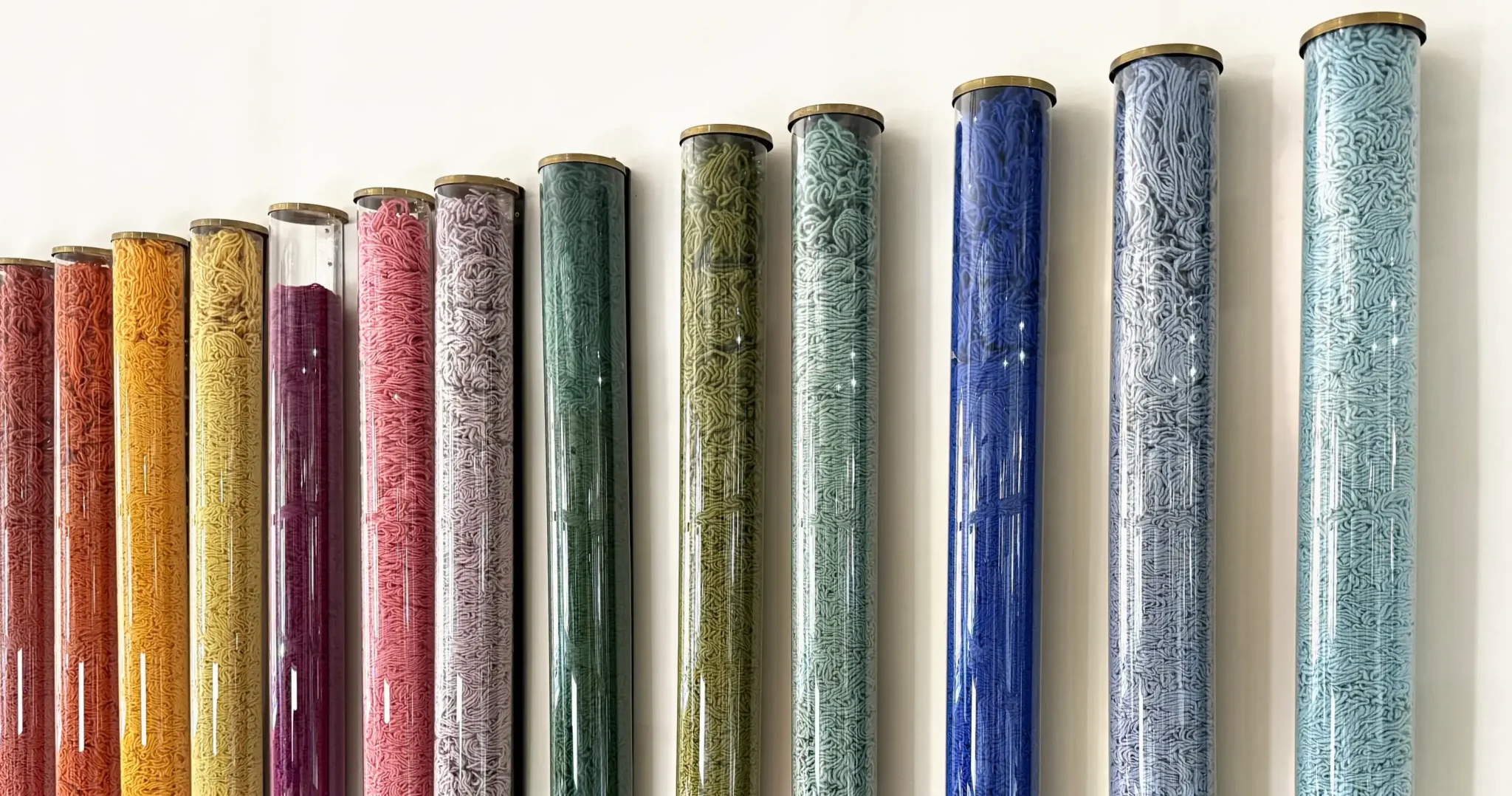
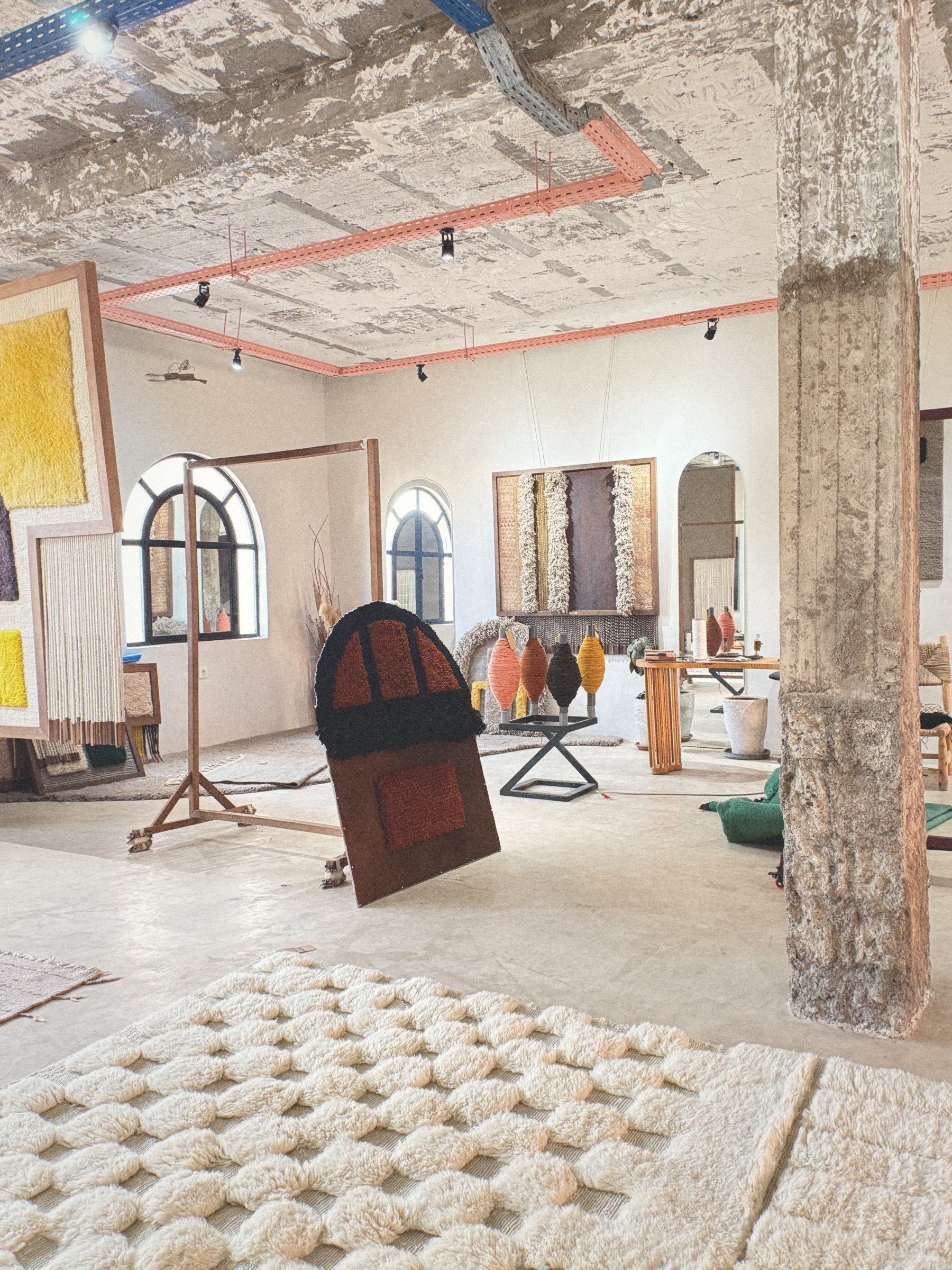
The studio is the story, so here it is, without staging. A relief rug in ivory wool in the foreground, raised in rounded tufts. A raw concrete column. A wall piece shaped like an arched window, propped on its back panel. Spools of dyed wool on a steel stand. In the next room, a long brown runner whose pile is cut into a maze of raised blocks, under skeins of wool hanging from a wooden tripod. Elsewhere on the floor, flatwoven panels with geometric motifs, dated September 2026.
The sketchbook
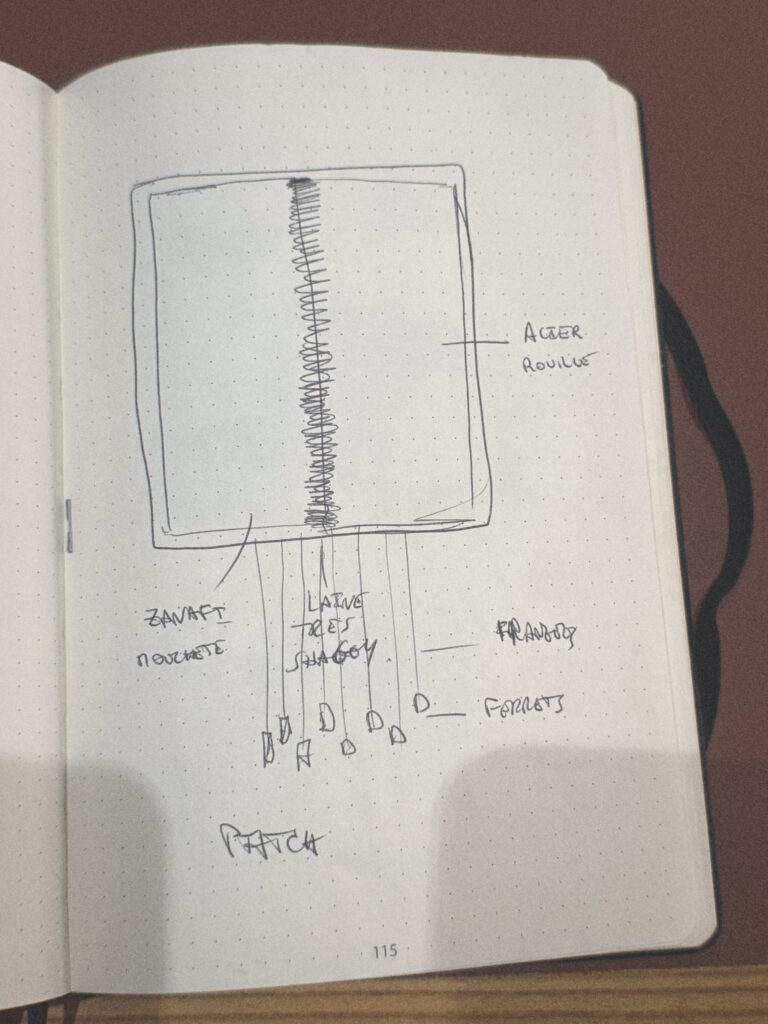
Everything starts on paper. Page 115 of my current sketchbook: a square frame, a vertical line of very shaggy wool running down its centre, and annotations rather than ornaments, « rusted steel » for the frame, « very shaggy wool », « fringes », and « ferrets », the small finished tips at the end of each strand. The drawing is for an experimental product. A drawing in the studio is a list of decisions about material before it is an image.
Samples before rugs
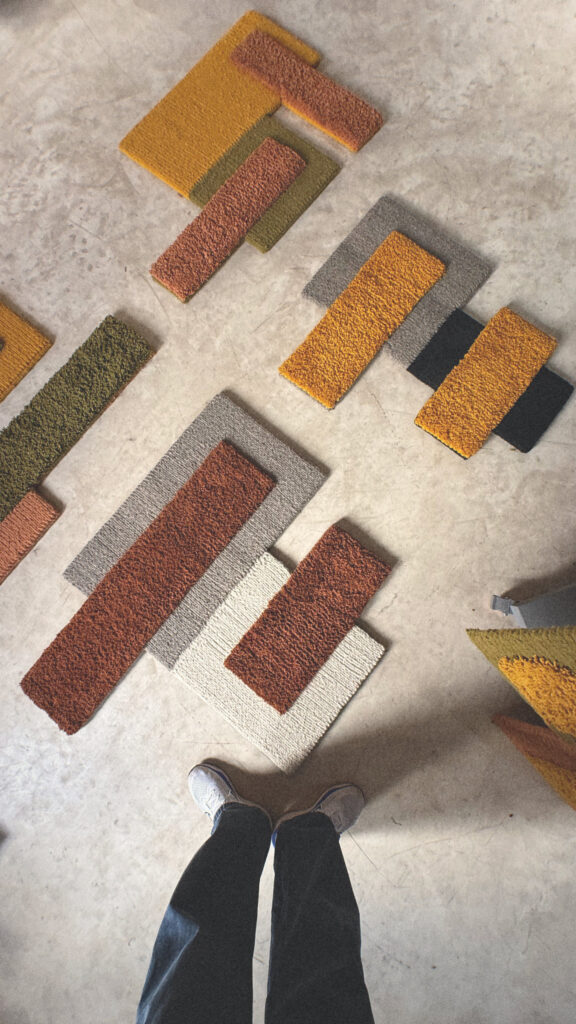
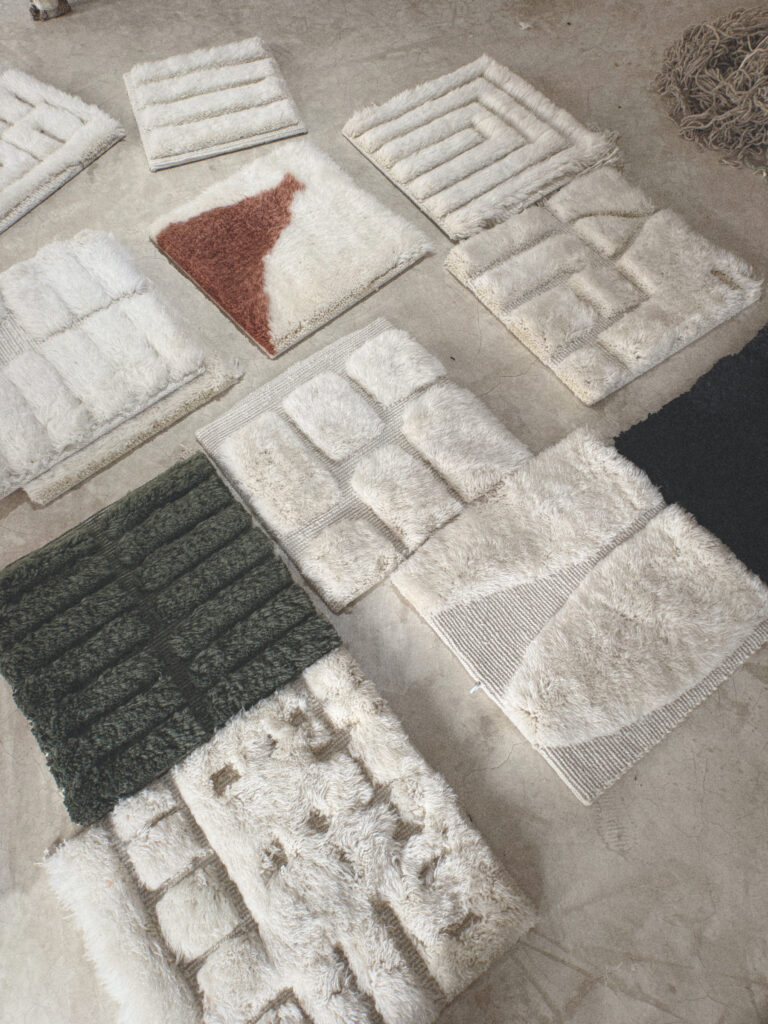
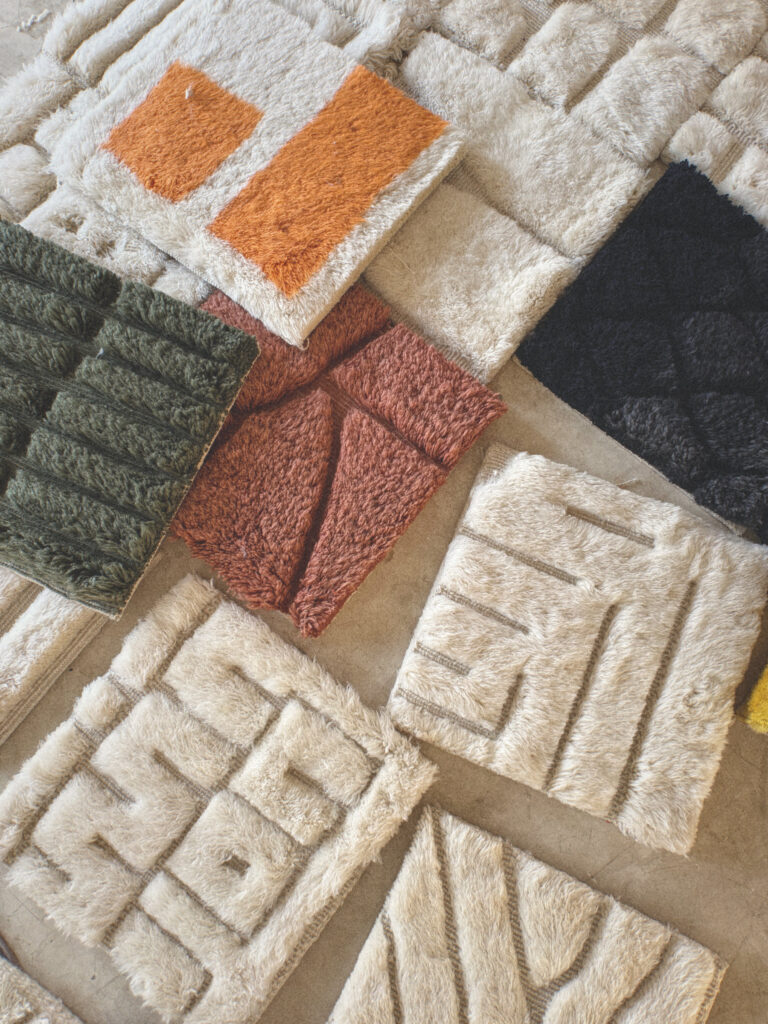
Before a full piece exists, it exists at sample scale, on the studio floor. Rectangles of mustard, rust, olive, grey, ivory and black wool laid over one another to test how two colours meet and how two pile heights sit together. Squares of ivory wool carved in relief, channels, steps, grids, next to the same logic in olive green, rust and black.
This is where most decisions are made. Pile height, the depth of a carved line, the point where a colour stops: these are architectural questions at the scale of a hand, and it is cheaper to answer them here than on a finished rug.
The practice next door
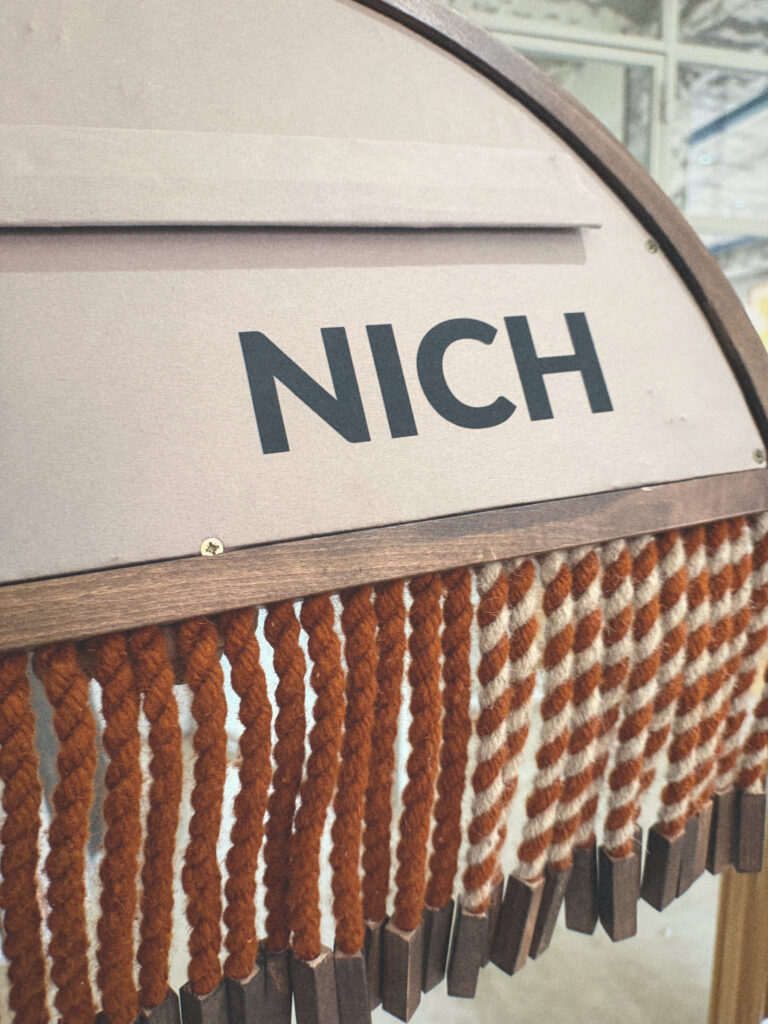
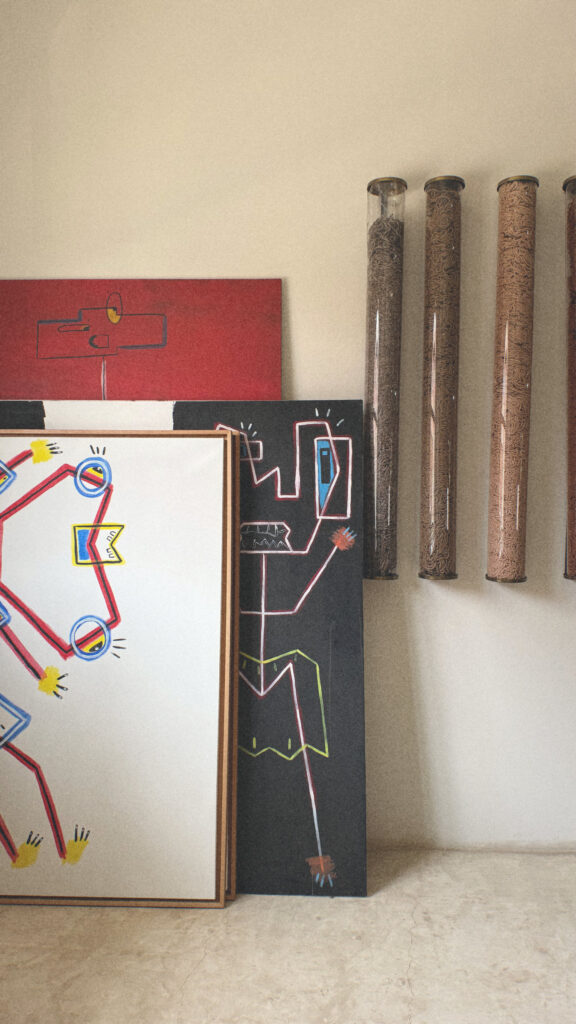
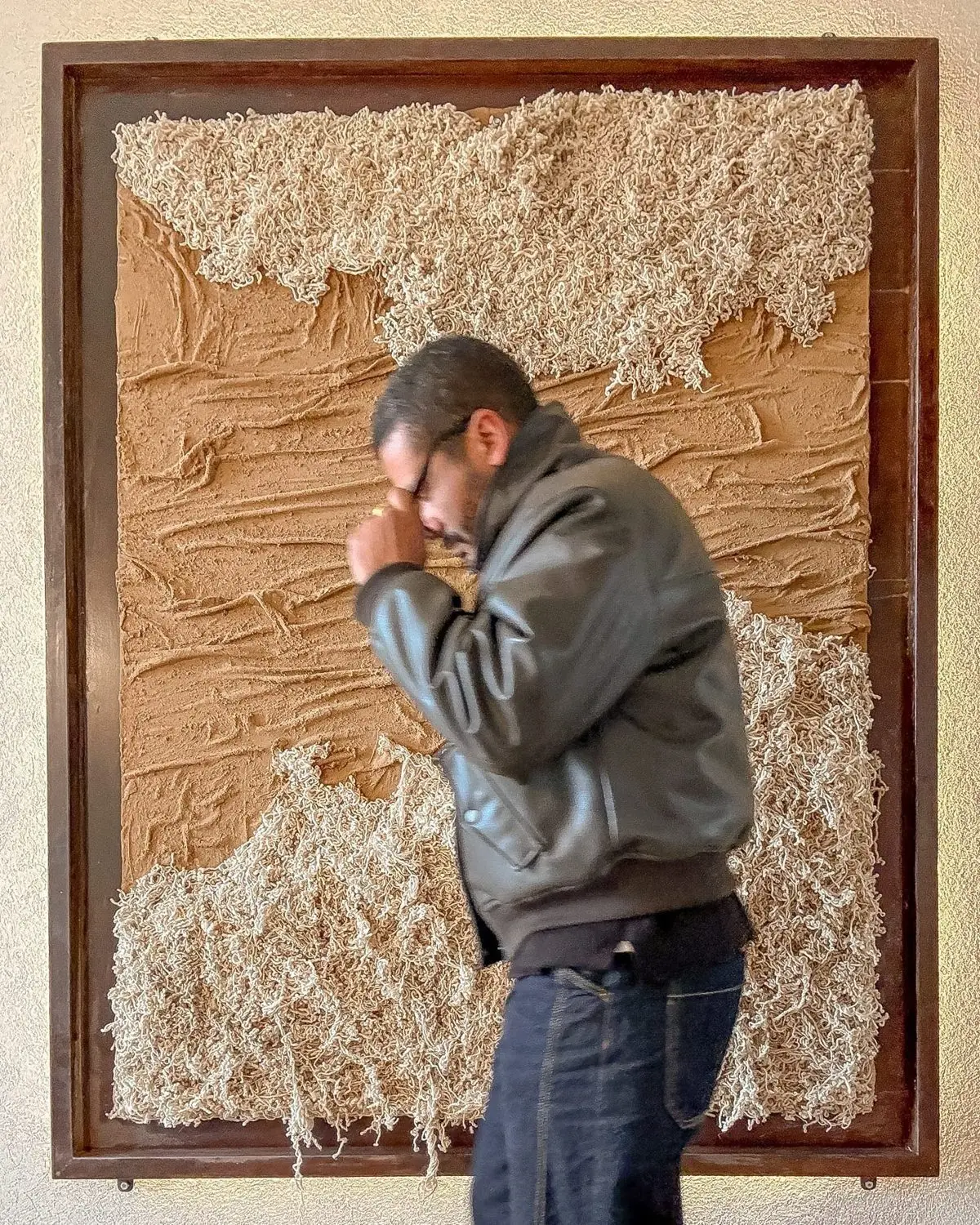
My own work with wool and textile art lives in the same building and feeds the studio directly. Twisted fringes in rust and ivory wool, each strand closed by a small wooden tip, hanging under an arched panel. Paintings leaning against the wall, next to clear tubes filled with wool. The rug collections do not copy these works; they borrow their freedom with form, colour and finish.
Working with the studio: what changes for architects and designers
Can a rug be designed at the start of an architectural project? Yes, and that is now how we prefer to work. In practice:
- We work from your plans. The rug is drawn against the room: its walls, openings, columns and circulation.
- Dimensions are adapted to the space, not chosen from a standard list.
- Wool samples let you judge colour and texture in your own light, next to your other materials.
- Projections in the space are made at the Lab from everything you send us, moodboard and on-site photos included, so you see the piece in the room before production.
- Collections can be customised in dimensions, colours and composition, or a piece can be designed together from the start.
- Lead time: 10 to 12 weeks up to 3×2 m, 12 to 14 weeks above, from production launch.
The details are on the Trade Program page.
What this chapter is not
It is not a new logo on the same company. The change was already in the way we worked; the name, the site and the Journal only make it visible.
It is not a break with where we started either. We build on what the studio knows about wool and hand techniques, and we use that knowledge to explore new forms, textures and compositions. Making matters. But the creative intention is what leads.
And it is not an ending. A studio that calls itself a lab has to keep testing. This Journal is where you will see it happen: the sketches, the samples, the projects, and the pieces that did not make it.