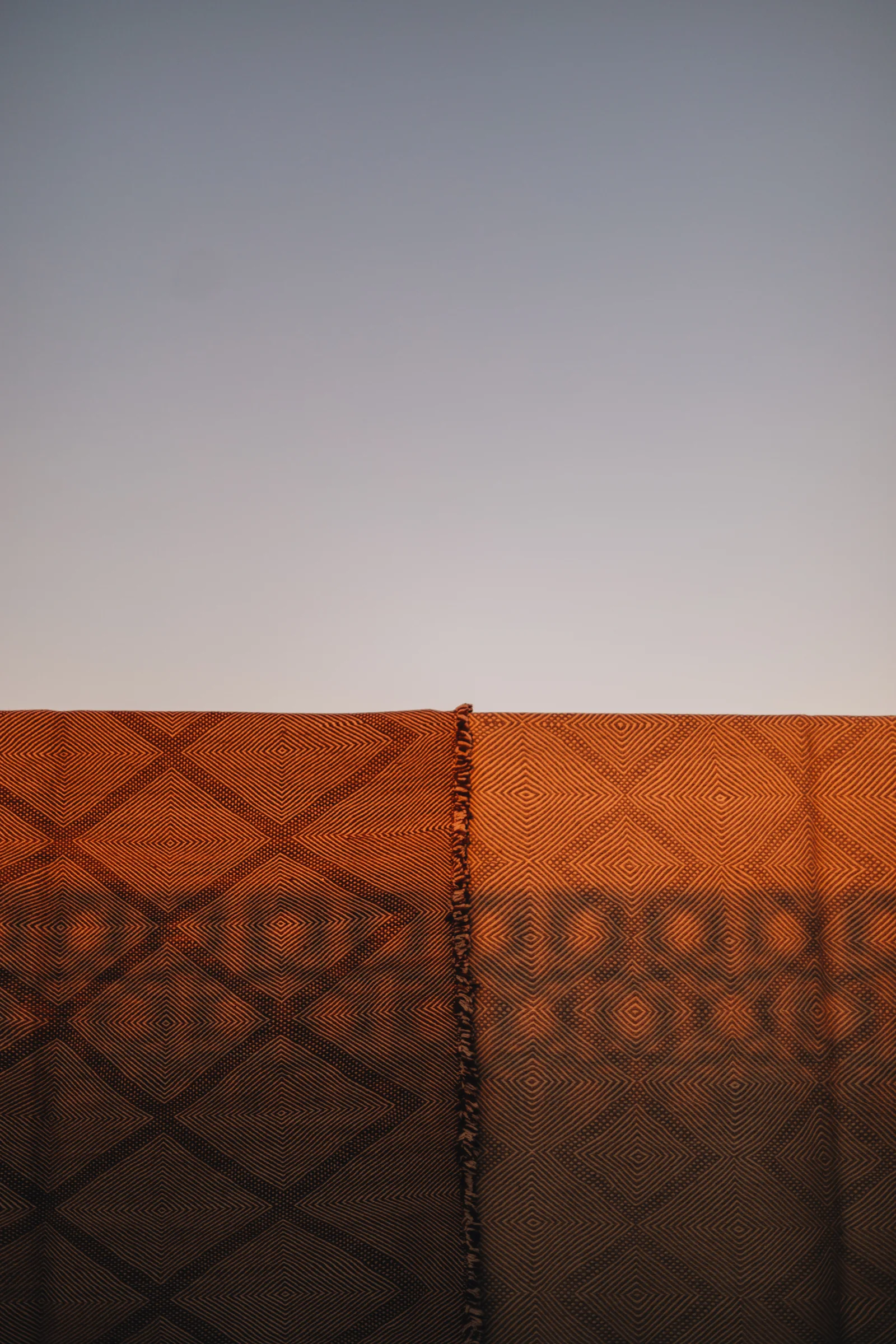
Rugs, weavings, pottery, jewellery, tattoos, the painted walls of earthen houses: across the Amazigh world, from Morocco to the Siwa oasis in Egypt, objects carry signs. Zigzags, chevrons, diamonds, triangles, crosses, dots. Today we see them as decorative geometry; for those who drew them, they were long a language.
Where Berber symbols come from
Berber signs recall the prehistoric rock engravings and ancient pottery found across the Maghreb, hence the frequent comparison with cave art. They come from a life lived close to nature and its cycles: earth, water, seasons, animals, birth and death.
Their meaning is not fixed. It changes from region to region, from tribe to tribe, from weaver to weaver, and many of the readings found today are interpretations passed on orally or put forward by researchers and collectors. Read them as leads, not as a dictionary.
Tattoos, the oldest surface
Tattooing, called “ticheret”, “aayacha” or “wachem” depending on the region, is often described as the oldest rite of Berber culture. It was worn mainly on women’s faces and bodies: forehead, cheeks, chin, hands, ankles. Dots, rows of dots, lines, twisted lines, Vs, crosses, squares, circles, triangles, plant and animal forms.
Tattoos had several roles: beauty, belonging to a group, protection against the evil eye or illness, fertility. Henna has now replaced permanent tattoos, once made with charcoal or kohl.
Berber symbols and their meanings on rugs
Women weave the rugs, and the patterns follow their inspiration. The most widespread readings link these signs to the life of the couple and the family: man, woman, meeting, union, fertility, pregnancy, birth. A weaver will often say that “making a rug is like making henna”.
Feminine signs
- The diamond: the most common motif on Berber rugs, read as the womb; with double hooks, birth.
- The X: the body opening to give birth.
- The chevron: a woman’s legs, femininity.
- The weaving comb: fertility and creation.
Masculine signs
Lines, bands, stripes, fishbones, ladders. The snake, and the bull for strength. Masculine motifs often come in threes: three lines, three bands. They tend to frame the feminine signs.
Signs of union and protection
- The cross: union, the meeting of two principles.
- The circle: harmony, the cycle, the absolute.
- The eye and the fish: protection against the evil eye.
Animals and plants
The same readings give meaning to many motifs:
- The spider: the sun, patience, work.
- The anchor: fidelity, balance.
- The ram: fertility.
- The olive tree: quiet strength.
- The swallow: femininity, the return of spring.
- The lizard: elevation.
- The salamander: regeneration.
- The bee: abundance.
- The snail: fertility, the harvest cycle.
- The scorpion: danger, or courage.
Lizards, fish and salamanders appear mostly on jewellery and pottery. The fibula, the large silver brooch that fastens a garment, protects; it could also signal that a young woman was promised.
On pottery and jewellery
Pottery, shaped by men or by women, carries geometric signs and human and animal figures close to those of tattoos and jewellery. They often speak of the village or the tribe. Objects follow their time too: an aeroplane or a car on a recent pot is not unusual.
Colours
They vary by region; red, black and yellow remain the most common.
An ancient abstraction
These signs are a code of values and social norms as much as a repertoire of forms. They have lasted because they are simple: a few lines are enough. That same economy runs through modern abstraction, and still feeds contemporary design.
Read further: the Beni Ouarain, from tribe to rug, the Azilal rug and Moroccan craftsmanship in all its forms. How the studio draws and makes its pieces is on the Production page.