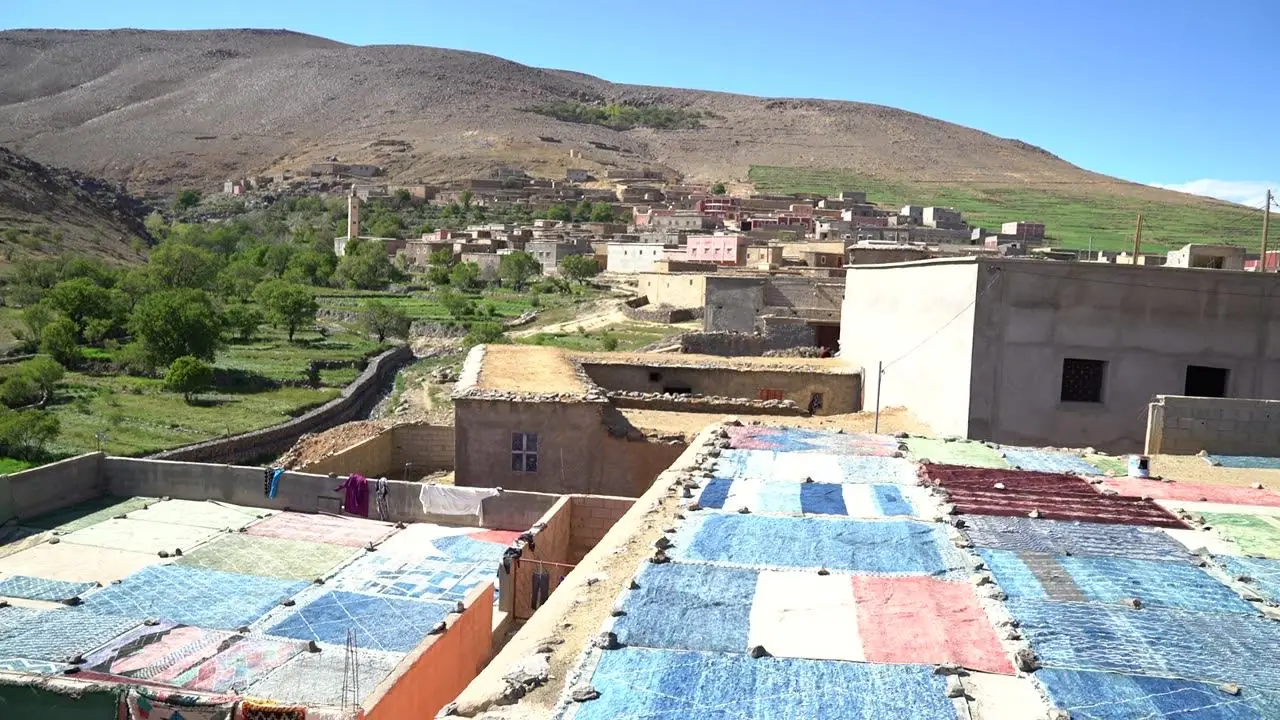
Morocco’s imperial cities have their medinas, monuments and gardens. But the country also reveals itself off the main roads: in Atlas valleys, the earthen ksour of the south, oases and mountain villages. Here is a short selection, grouped by the cities you set out from.
Around Marrakesh
The Ourika valley
An hour from Marrakesh, the Ourika river has given its name to a whole valley. Orchards, earthen villages, small cafés by the water and, at the end of the road in Setti Fatma, a chain of waterfalls reached on foot. The valley changes with each season: blossom under the snow in spring, cool air in summer.
Imlil
Imlil is a typical Berber village in the High Atlas and the starting point for climbing Jbel Toubkal (4,167 m), the highest peak in North Africa, in Toubkal National Park. Guides and muleteers are available there; the ascent usually takes two days, with a night at the refuge.
Tighouine and the Yagour plateau
About an hour from Marrakesh, Tighouine is a small, lively village known for its springs, and a gateway to the quiet Zat valley, often explored by mule. Above it, the Yagour plateau is known for its rock engravings and views.
Around Ouarzazate
Aït Benhaddou
Before Ouarzazate, the ksar of Aït Benhaddou, a fortified earthen village on a hillside, has been on the UNESCO list since 1987. Its lanes and covered passages have served as a set for many films.
The Dades valley and the valley of roses
East of Ouarzazate, the Dades road crosses Kelaat M’Gouna and the valley of roses, home of Moroccan rose water, then leads to the Dades gorges, between red cliffs and terraced fields.
The Draa valley
To the south, the Draa valley runs down to Zagora for more than 200 kilometres: palm groves, kasbahs, ksour and Berber villages along the river.
Merzouga, at the edge of the desert
Two roads lead to the dunes: via Errachidia to Merzouga and Erg Chebbi, near the Algerian border, where the dunes begin at the edge of the village; or via Zagora to M’Hamid and Erg Chegaga, deeper in the desert.
Tamegroute
Near Zagora, Tamegroute is the potters’ village, home of the green-glazed ceramics recognisable at a glance. More in Moroccan and Berber pottery.
Around Agadir
Paradise Valley and Imouzzer
Inland from Agadir, Paradise Valley strings together gorges, natural pools and palms. Higher up, Imouzzer Ida Outanane is known for its waterfalls, best in spring, and for its honey.
Amtoudi
Between Bouizakarne and Tata, Amtoudi sits below cliffs and two old fortified granaries, the agadirs (igoudar). A path follows the river to a guelta, a spring-fed pool.
Around Tangier
Chefchaouen
A little over a hundred kilometres from Tangier, in the Rif, Chefchaouen is the blue town: walls washed in blue lime, stepped lanes, and Outa el-Hammam square at the heart of the medina.
Further afield
The oases of Figuig, Fint or Tazzarine, and in the far south, the Dakhla lagoon, its white dunes and beaches.
To go further: Berber culture and history.
The Tribaliste studio is based in Marrakesh; its news is in the Journal.