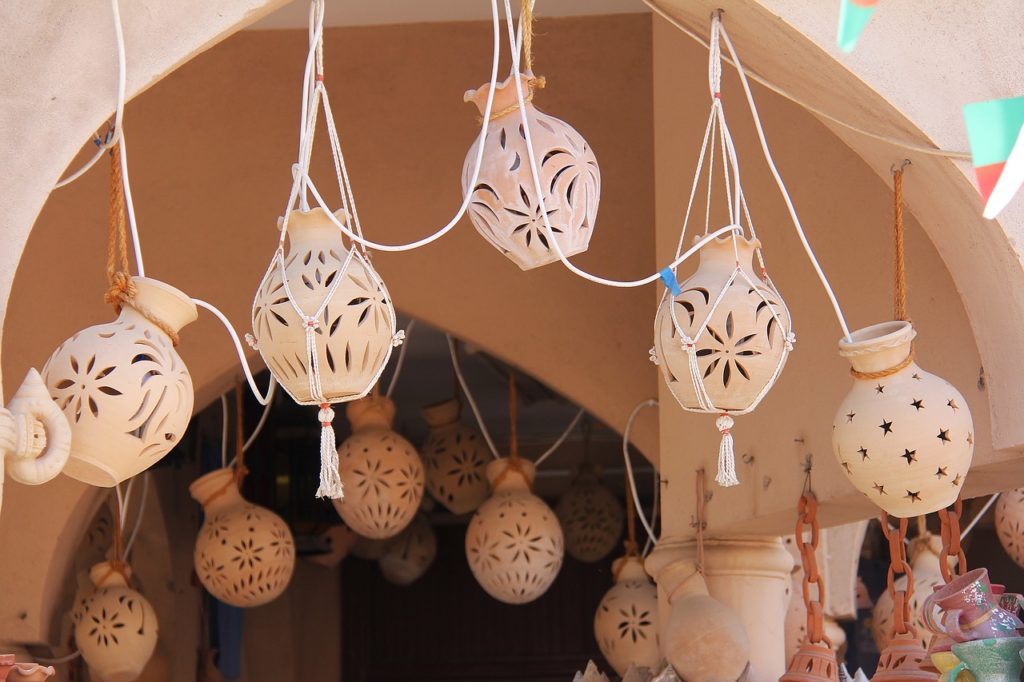
Pottery has been part of Moroccan daily life for centuries, like bread and tea. Each city and region has its forms, colours and gestures. From the great centres of Fez, Meknes, Safi, Salé, Marrakesh, Tetouan and Azemmour to the villages of the Rif and the south, Moroccan pottery falls into two families: urban pottery and rural, Berber pottery.
Clay and gesture
Morocco has abundant, high-quality clays. Clay is first dried in the sun, then wetted, kneaded and left to rest for several days. In the cities most potters, men, throw on kick wheels. In the Rif, women build their pieces by hand, with coils, without a wheel.
Firing is usually done in traditional kilns, around 900 °C, for several hours; pieces cool slowly before being decorated or not. In Salé some pieces are fired twice. Gas kilns have been offered to save wood; in Tamegroute potters went back to the traditional kiln, whose results they prefer.
Types of Moroccan pottery
Fez: cobalt blue
Fez pottery is known for its blue on a white ground. It includes fine faience, glazed ceramics and decoration drawn from Islamic art.
Safi: polychrome
Safi, the great pottery town of the Atlantic coast, works greens, yellows and browns. Its polychrome, dropped in the nineteenth century for the blue and white of Fez, was later revived. The National Ceramics Museum in Safi traces these techniques.
Salé: restraint
Salé pottery is sober in form and muted in colour, with outlines and motifs often incised.
Meknes and Marrakesh
Meknes has its own green. In Marrakesh pottery serves the kitchen: tanjia, meat slow-cooked with preserved lemon, is made in a terracotta jar of the same name.
Tamegroute: the green of the Draa valley
In the Draa valley, Tamegroute pottery is recognised by its green glaze, sometimes ochre or brown, glossy and irregular, whose recipes the potters keep to themselves.
Berber pottery
Berber, or Amazigh, pottery is first a pottery of use, made for the home: jars for grain, olives, oil or dried fruit, tajine and couscous dishes, jugs, kneading bowls, small braziers called “kanoun”. In some mountain areas, large earthen jars still serve as larders.
It is mostly made by women, by hand, in sun-dried or fired clay. Some pieces are bare; others carry simple motifs in touches of white, black or brown, in natural pigments that sit with the colour of the earth. Tools are basic, forms often recall antiquity, and each piece keeps its irregularities.
Rif pottery
In the Rif mountains and foothills, pottery is women’s work. Long made for the family rather than for sale, it is now sought after for its forms and fine decoration.
Pottery, zellige and tadelakt
Terracotta has two cousins. Zellige is made of glazed, fired clay tiles, then cut by hand into small shapes that make up geometric mosaics. Tadelakt is a Marrakesh lime plaster, polished with a river stone in circular movements, then sealed with black soap until smooth and waterproof. Applied to vases and objects, it gives pieces with very contemporary lines.
A changing craft
Plastic, industrial ceramics and the cost of small workshops have reduced the number of potters. The craft carries on through cooperatives, training, notably in Salé, and a renewed taste for handmade terracotta at home.
Read also: basketry, techniques and materials and Moroccan craftsmanship in all its forms. The studio’s materials are on the Materials page.